-
Ancient Powerful Temples of Kashmir
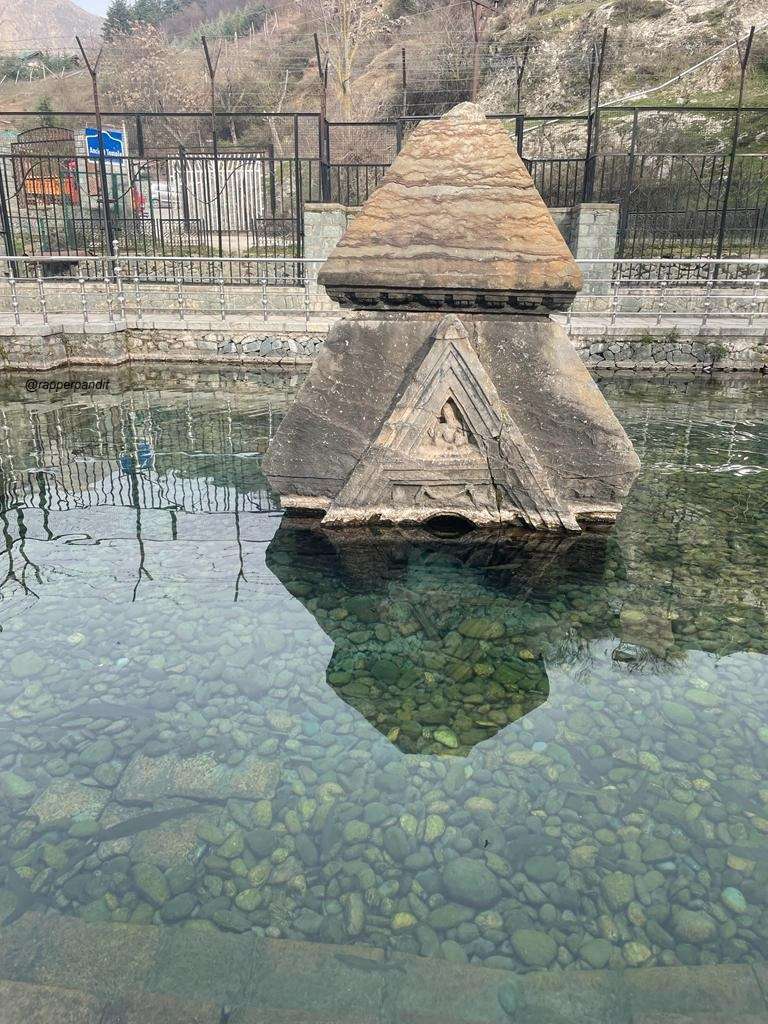
Kashmir witnessed a flurry of tourists after Covid pandemic was over. With 2 Crore Tourists visiting in Less than 6 months. an approximate 1 Lac Tourists every Day-Dal Lake, Nishat-Shalimar Garden, Pahalgam & Gulmarg being the Top Visited Places. If you have visited Kashmir in the past, you would have certainly visited these places. But did you visit the Ancient powerful religious and historical temples that still exist in Kashmir despite multiple holocausts since the last 700 Years.
Background
Kashmir (Kaśmīrā) has various other names like SatiSar सतिसर(the lake of devi Sati), SatiDesh सतिदेश(the land of devi Sati), SharadaDesh शारदादेश(The Land of Devi Sharada), Tapobhumi तपोभूमि (The land of Tapasya), ReshVaer रेश-वअर(The Garden of Rishis)
Today we will see important historical Ancient Powerful Temples of Kashmir which still exist, and History couldn’t erase it fully. This Article is a perfect trip planner for Kashmir that clubs scintillating beauty with fascinating Ancient Temples- lesser known to outer world.Let’s first start with reciting this Stotram of Devi Sharda (Maa Saraswati), the Goddess of Kashmir
नमस्ते शारदे देवी काश्मीरपुरवासिनि
त्वामहं प्रार्थये नित्यं विद्यादानं च देहि मे॥I bow down to you, Devi Sharda (Ma Saraswati), the one who resides in Kashmirpur (the area of Kashmir)
I regularly pray to you, and thus bestow on me the gift of Knowledge.There are three main versions which can be considered to be the Origin of Name Kashmir: Etymological, Historical, Religious.
Etymological: Nityanand Misra has clearly deciphered the name Kaśmīrā as a magnificient place worth going.
(कश्+म्+ईर = कश्मीर) from the Rules in Unadi Sutras. Mahabharat mentions words as Kashmiri, Kashmiraka, Kashmir-Mandala and Panini’s Ashtadhyayi also uses word as KashmiraHistorical: Nilmata Purana mentions that “Prajapati is called ‘ka’, and Kashyapa is also Prajapati. Built by him this country will be called Kaśmīrā
Religious: However, finally the name Kashmir boils down to name Kaśmīrā a form of Umā or Maa Pārvatī.
Please read till End To know some unknown or less explored Historical places and Powerful Temples of Kashmir
Kashmir is a place of many Shaktipeeths. Infact in Kashmir, you will find many Places called Devi-bal देवी-बल . Kashmir is also associated with Trika – Para, Para-Apara, Apara forms of Shakti which is considered the basis of Kashmiri Shaivism.
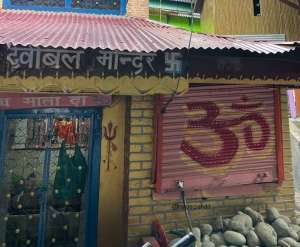
It is said that Pratyaksha Pramana (Eyewitness) is greater than Shabd Pramana (Documented Witness). So Today let’s see these living Historical Monuments, which you must visit Next Time you Go to Kashmir. It is a Complete Guide for you to see real Kashmir
Day-1 : Hari Parbat , Shankaracharya Temple, Zyestha Devi Temple
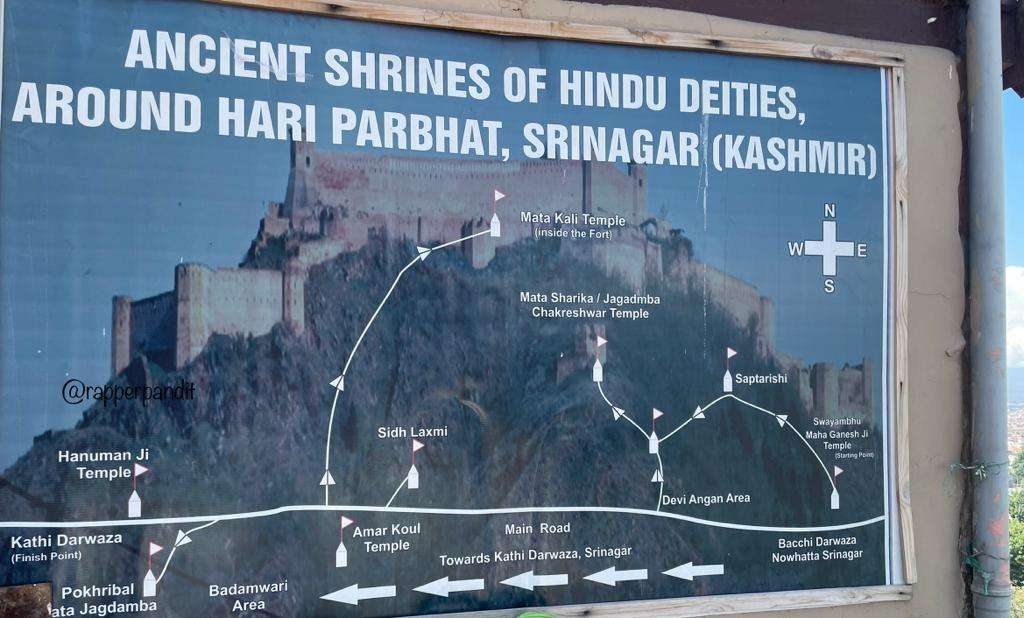
Club with Dal Lake, Nishat-Shalimar GardenHari Parbat : Less than 6kms from Dal-Lake. This is highly revered place of Kashmiri Hindus.
Google Map: https://goo.gl/maps/vHCoKKyg7Q6tyHpS8
Significance: Also known as Chakreshwar Temple, this place the Godess herself resides as Sri Yantra of Tripursundari. Hari in Kashmiri means a Bird (मैना) and Parvat means Hill. It is said that the Ashta bhuja Maa Durga Took form of a Bird (हअरि) and with pebble in her mouth and grew in size with the pebble so much that the pebble became as big as a Hill. This Pebble was then dropped on the Demon who was in the Satisar Lake to kill him under the enormous pressure of the Hill. Thereafter the Goddess manifested in the Form of Shila which is in the Form of a Yantra from Top View. This place has high importance in Shaivism
The City of Srinagar also derives its name from SriChakraZoom the Pictures to know the details
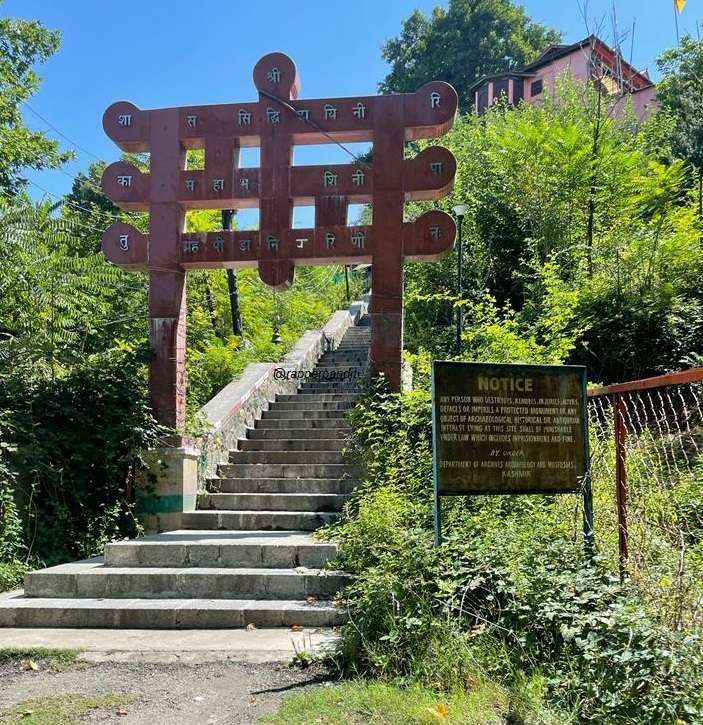
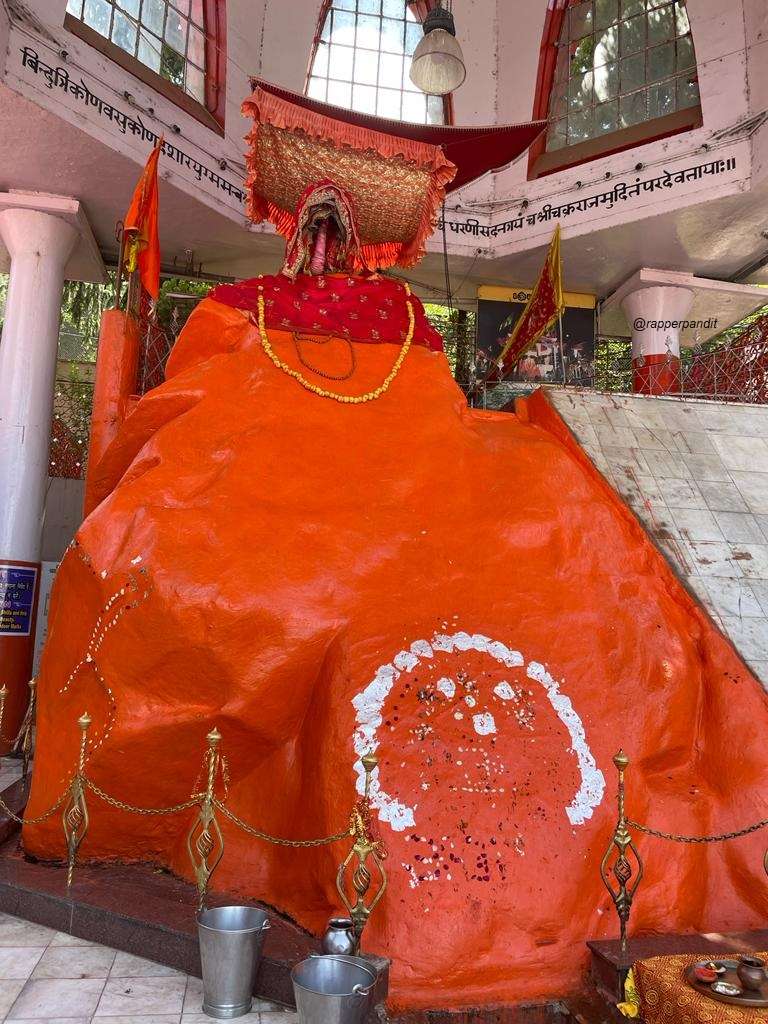
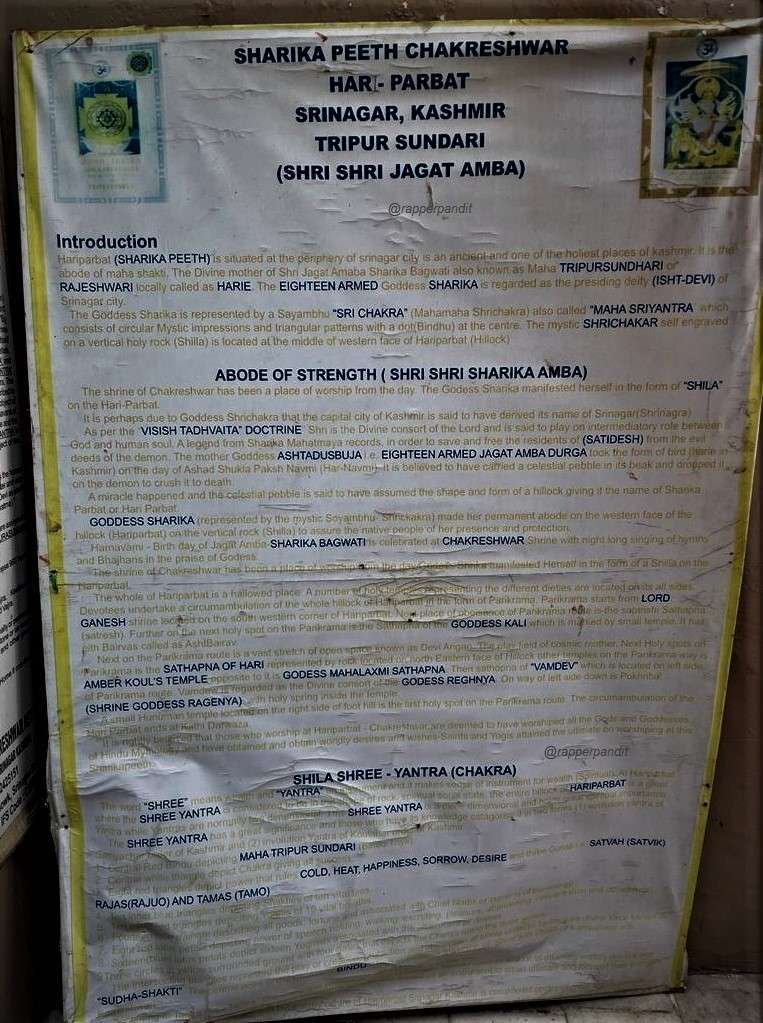
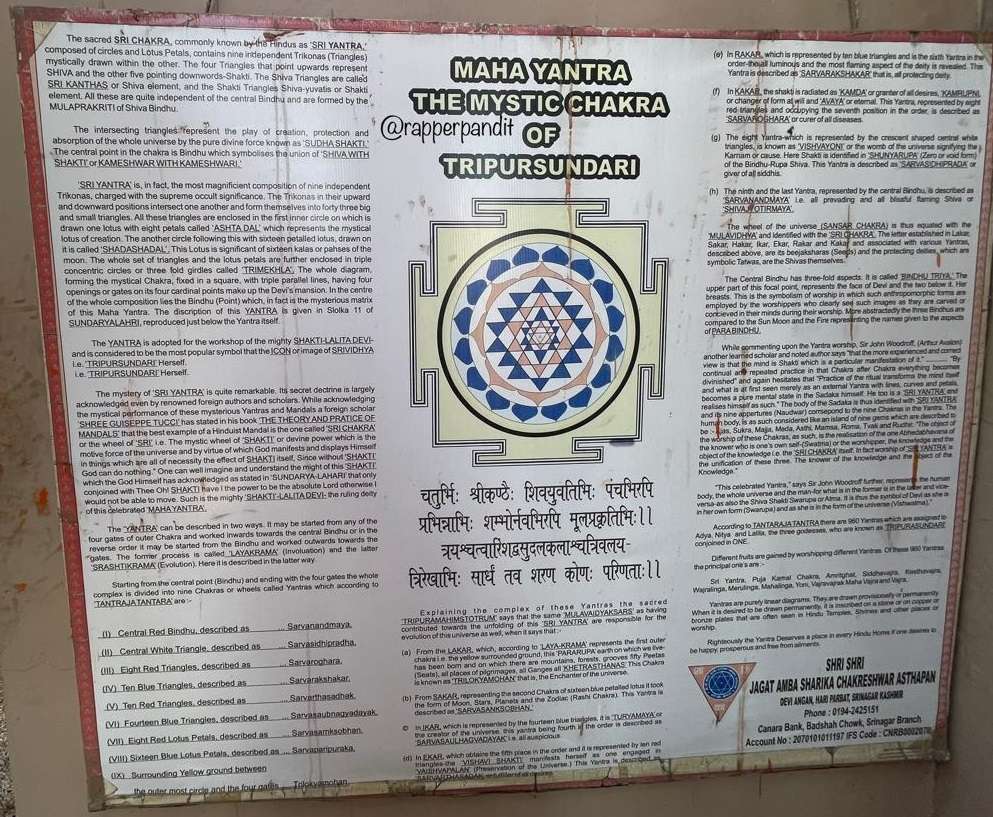
ShankaraCharya Temple: Less than 14 kms from Dal-Lake.
Google Map: https://goo.gl/maps/vbEcs6Bwmwv9qd5P7
Significance: Believed to be built King Gopaditya in 4th Century B.C. and later repaired by Lalitaditya Muktapida in 8th Century AD, this is believed to be the Oldest continuing temple of Kashmir. Originally known as Jyeshteshwara (Shiva) Temple, after the visit of JagadGuru adiShankarcharya, this Temple became famous as ShankaraCharya Temple. This is one of the places where adiShankaracharya meditated. The Cave where he meditated is still present there.
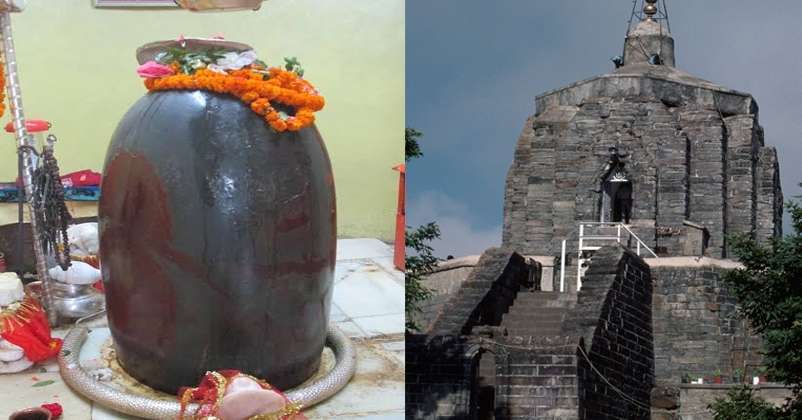
Jyestha/Zestha Devi Devi Or Zeathyar : Less than 8kms of Dal-Lake and 2kms from HariNiwas
Google Map: https://goo.gl/maps/a4SFcMAdXoWaiNLz8
Believed to be the Elder Sister of Ma Lakshmi Jyestha ज्येष्ठ देवी . It is very near to Gupkar (Guptagraha)- a Place where Asurs hid Mata Lakshmi after Ocean Churning and to free her, the powerful ज्येष्ठ देवी was brought in by Bhagwan Shiva along with Vira Vaitala. This temple is very important for Kashmiri Hindus. A very powerful goddess especially for the well being of children and mankind. It held great importance in Ancient Occult and Tantrik Practices.
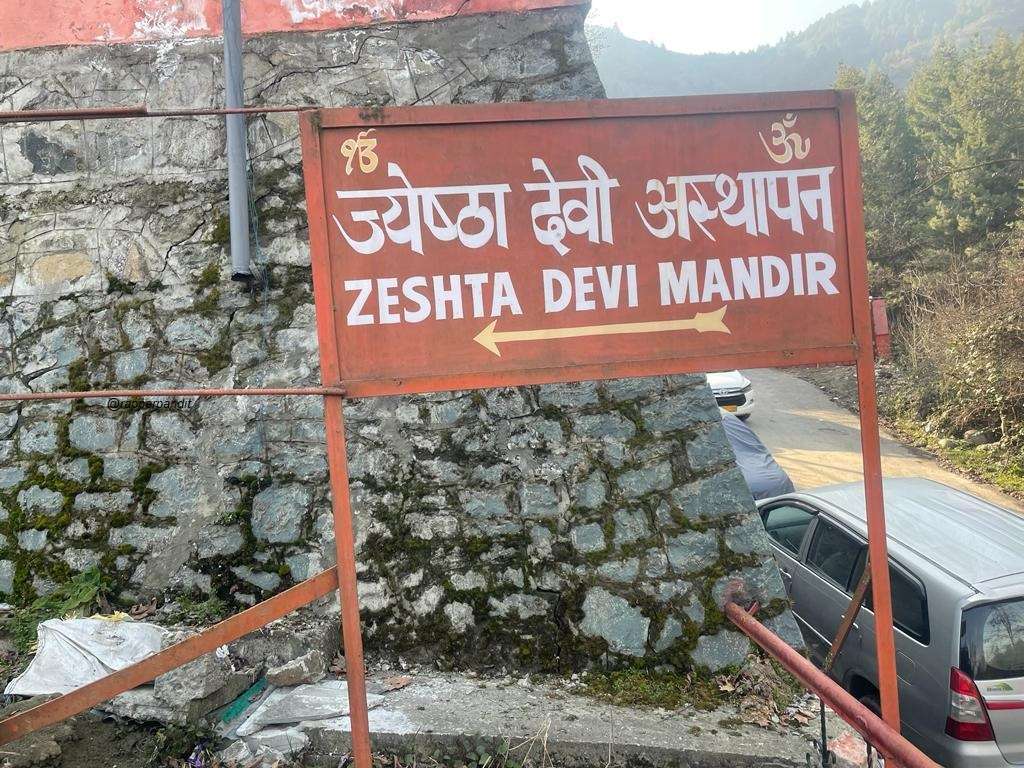
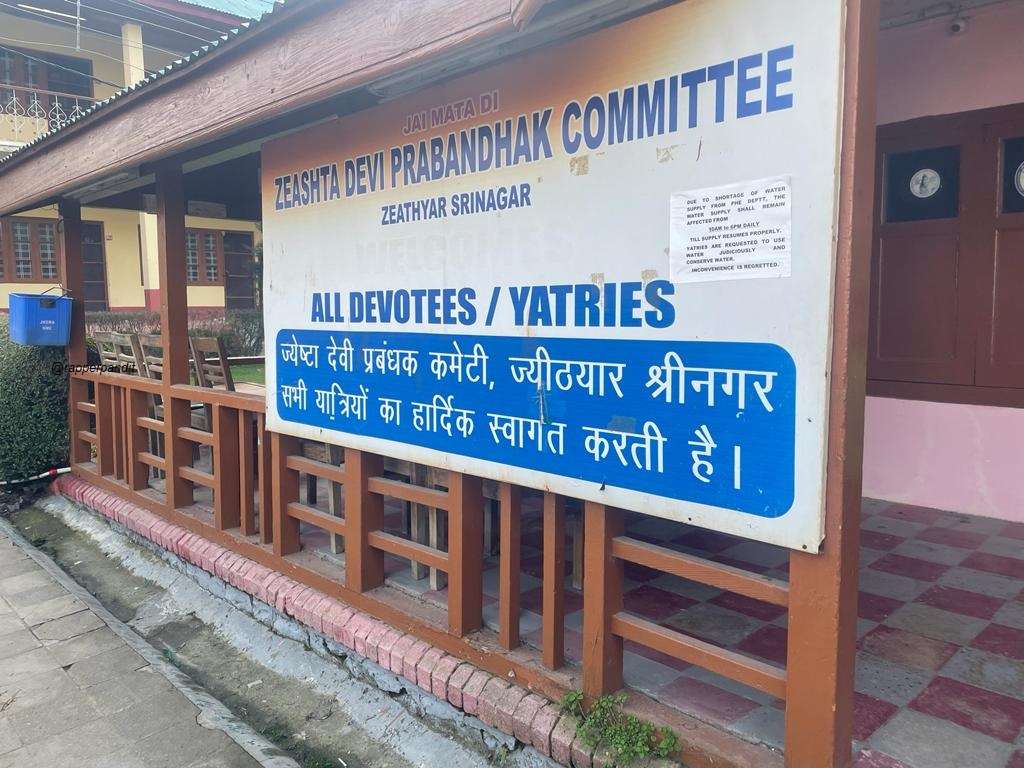
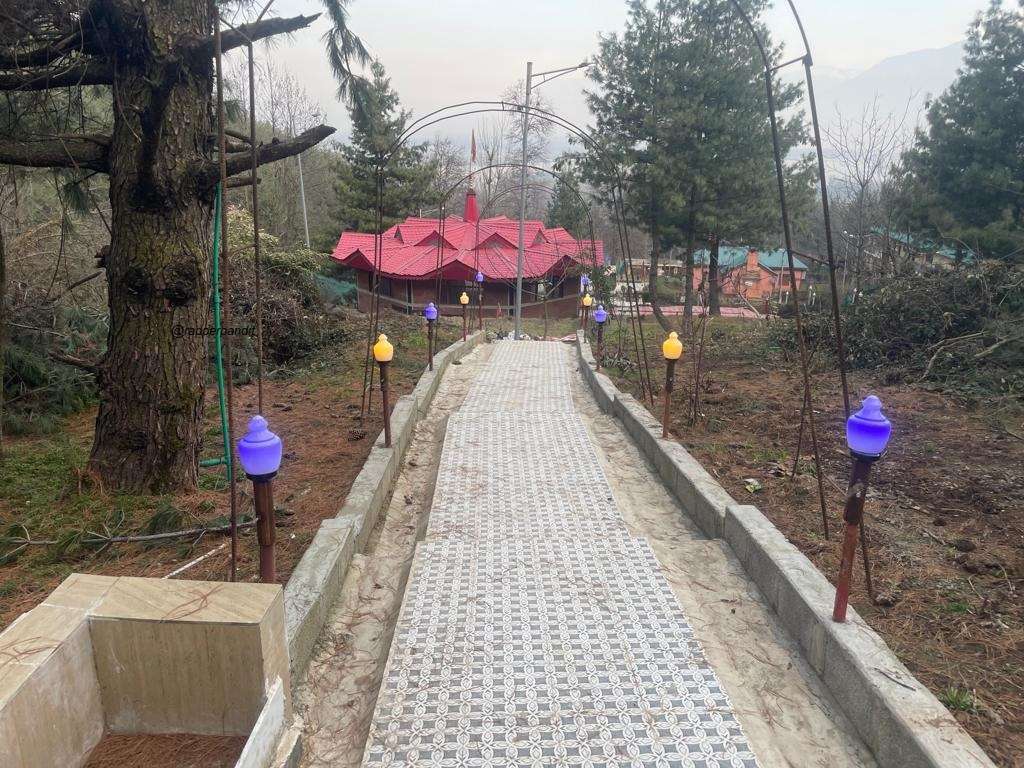

Day-2 : Mata Ksheer Bhawani Tulmul , Manasbal Temple
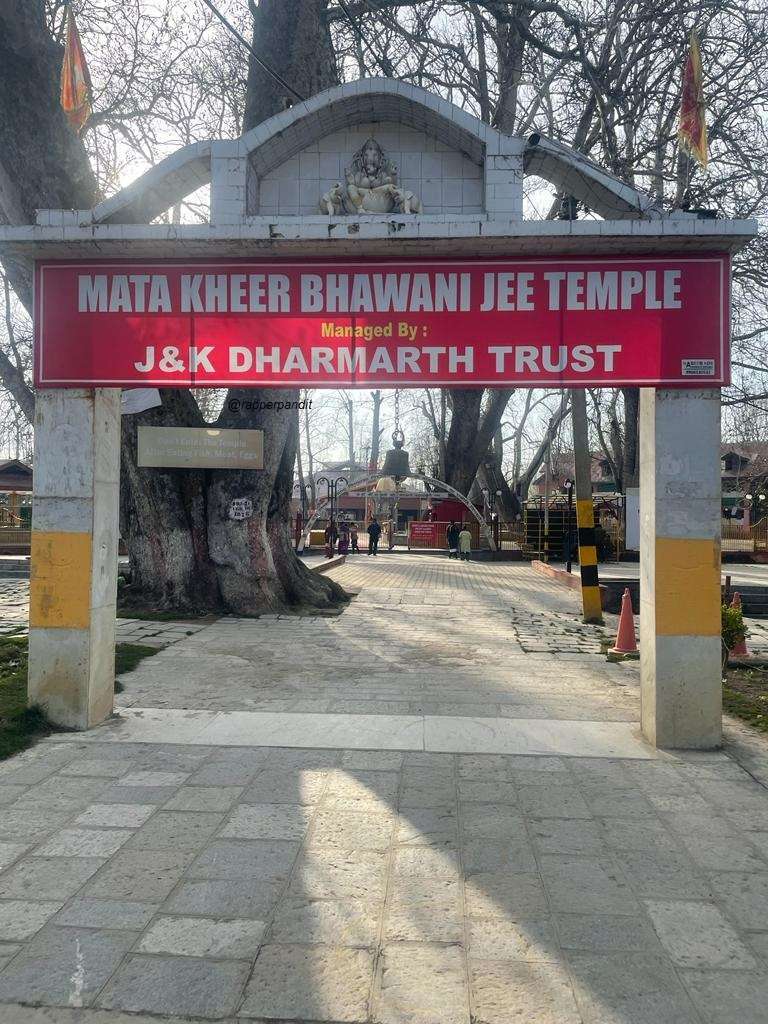
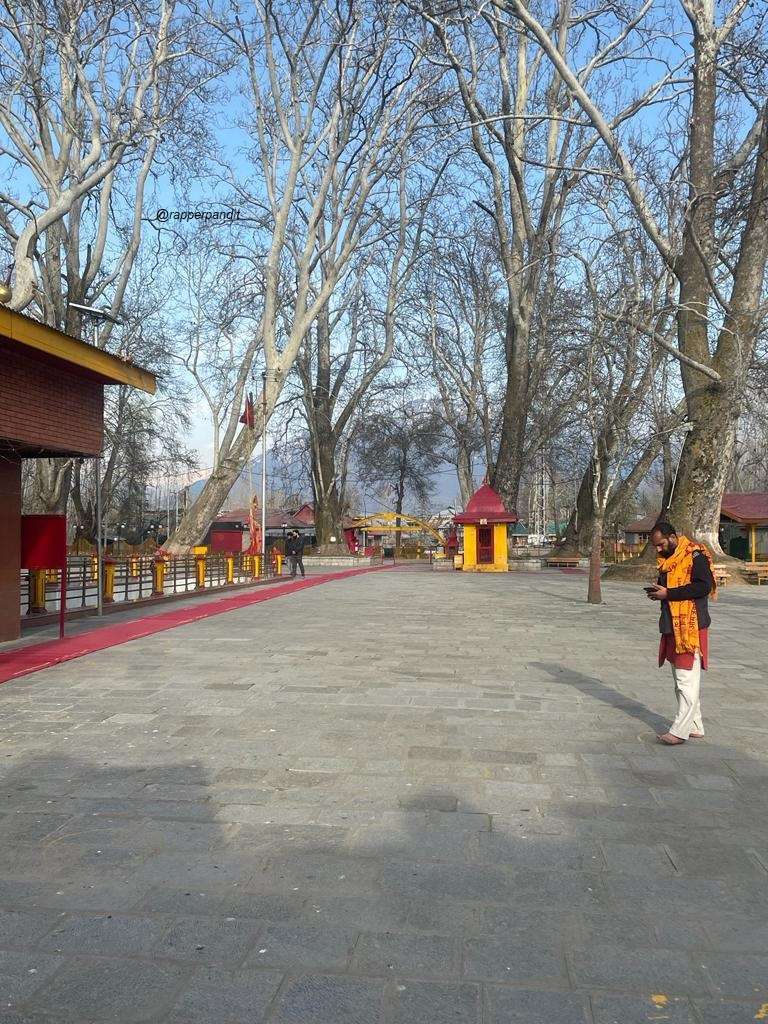
Club with Visit to Manasbal Lake and Asia’s Largest Fresh Water Lake- Wullar LakeMata Ksheer Bhawani Temple – TullaMulla, Dst Ganderbal – 24kms from Dal Lake Srinagar
Google Map- https://goo.gl/maps/5uTgGsP8EH5DTsd56
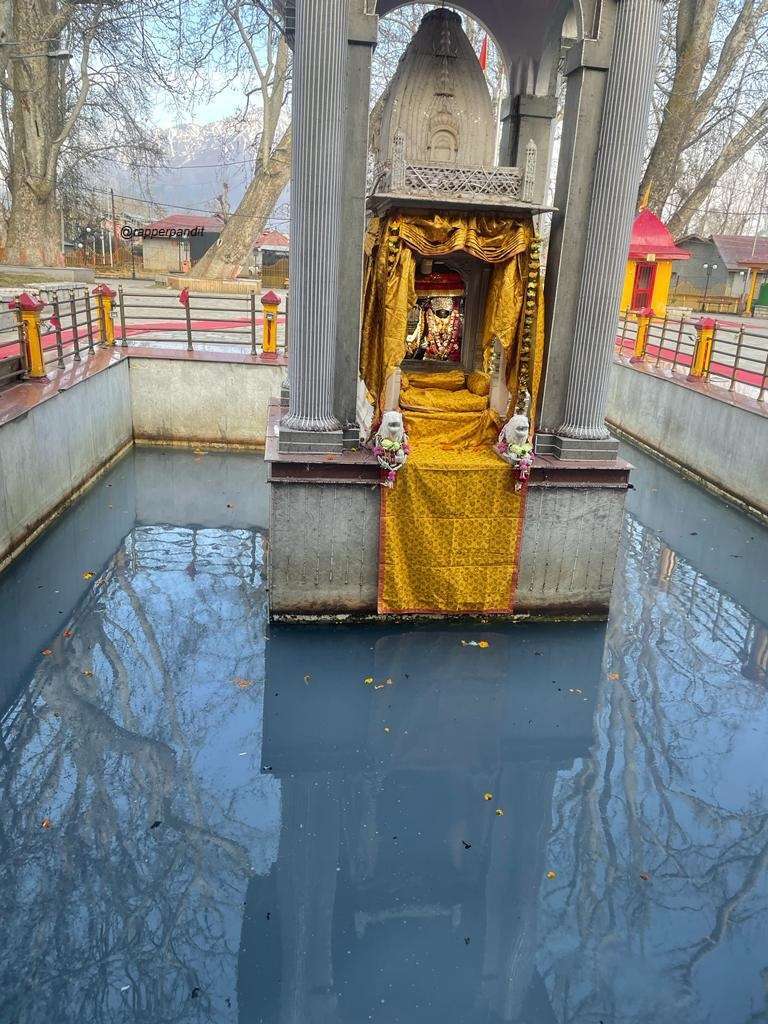
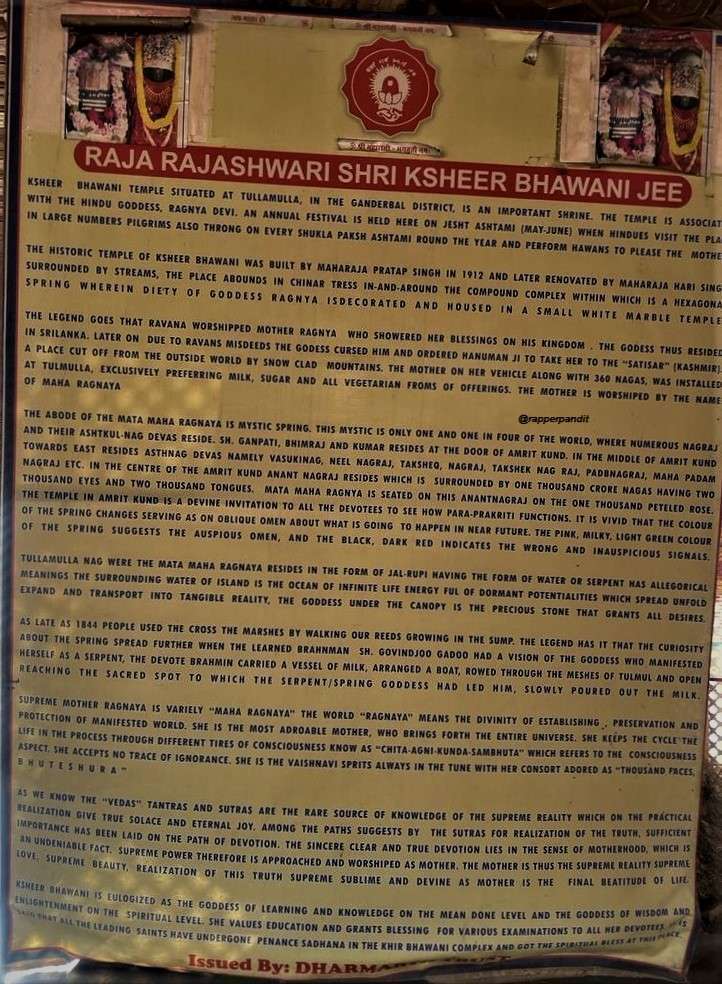
Significance: It is said Maa Ragnya Devi along with her 360 Nagas, came to this place from Srilanka and resided in this Spring on a 1000 hooded Nagaraja. This is a very auspicious and mystic place. The mother likes Milk क्षीर as offering, hence called Ksheer Bhavani. Whenever something Good or Bad Event of High Magnitude has to happen in Valley the Waters change its colours from Light Green/Pink/Milky to Black /Dark Red. Zoom into read the complete Story of this Highly revered place. No one after Consuming Non-Vegetarian food or Alcohol should enter this power place. This will bring great misfortune on him/her.
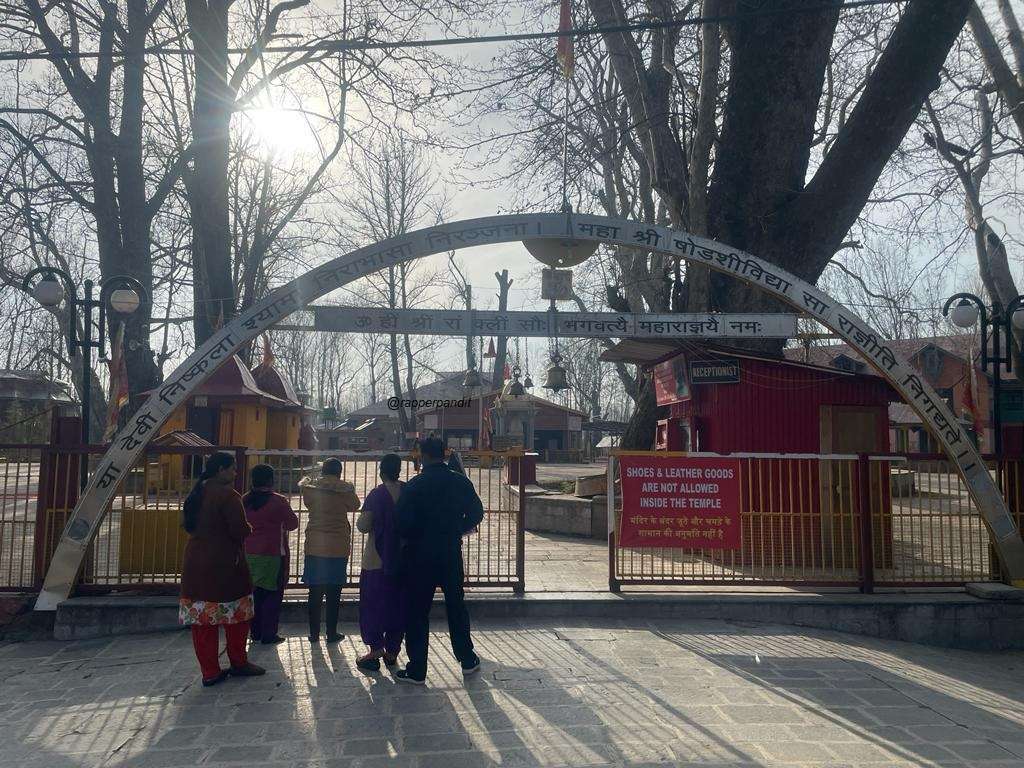
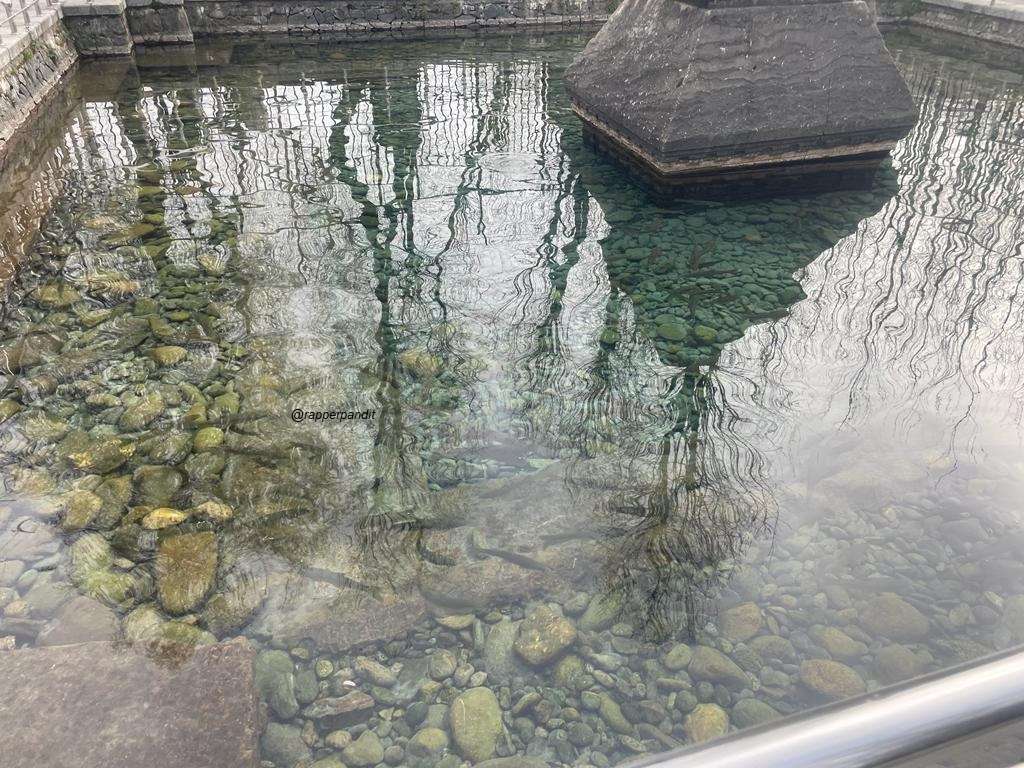
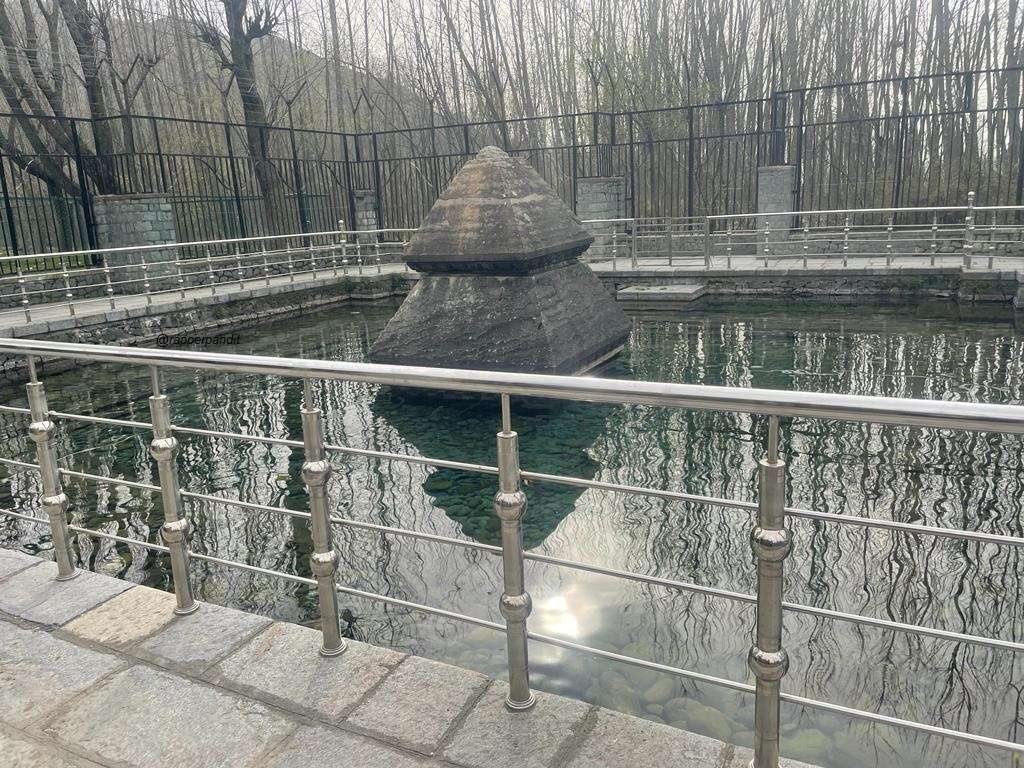
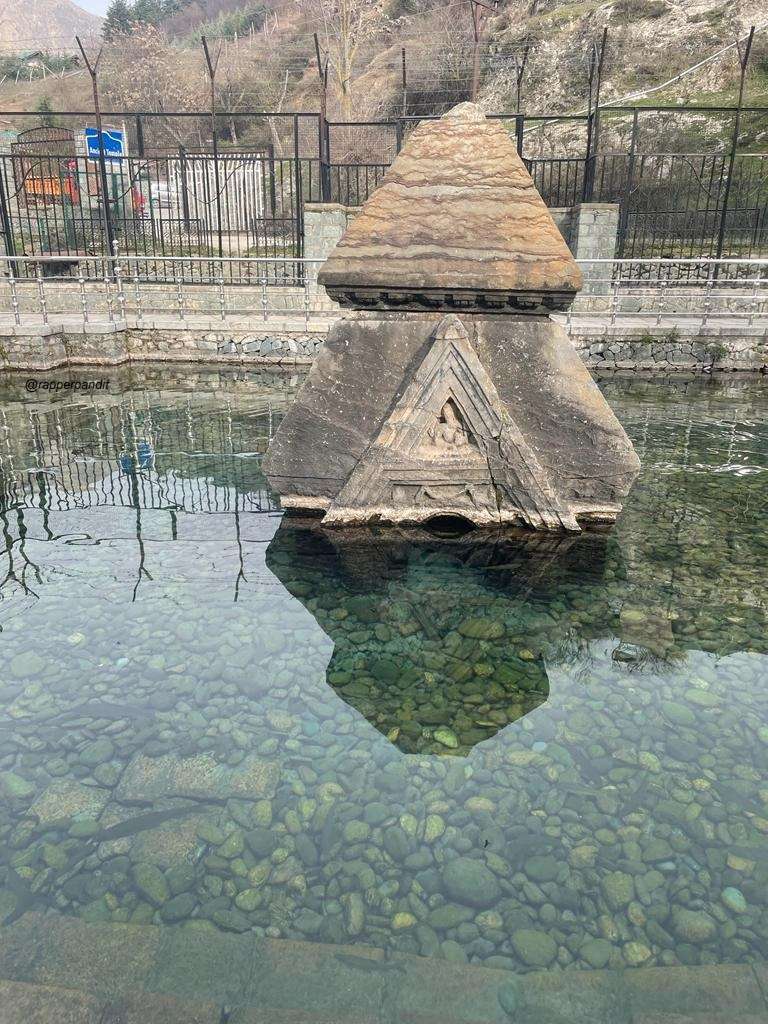
Manasbal Temple : 9kms from Mata Ksheer Bhavani Temple is the submerged Manasbal Temple
Google Map: https://goo.gl/maps/coXMNewiVzJUXnQF8
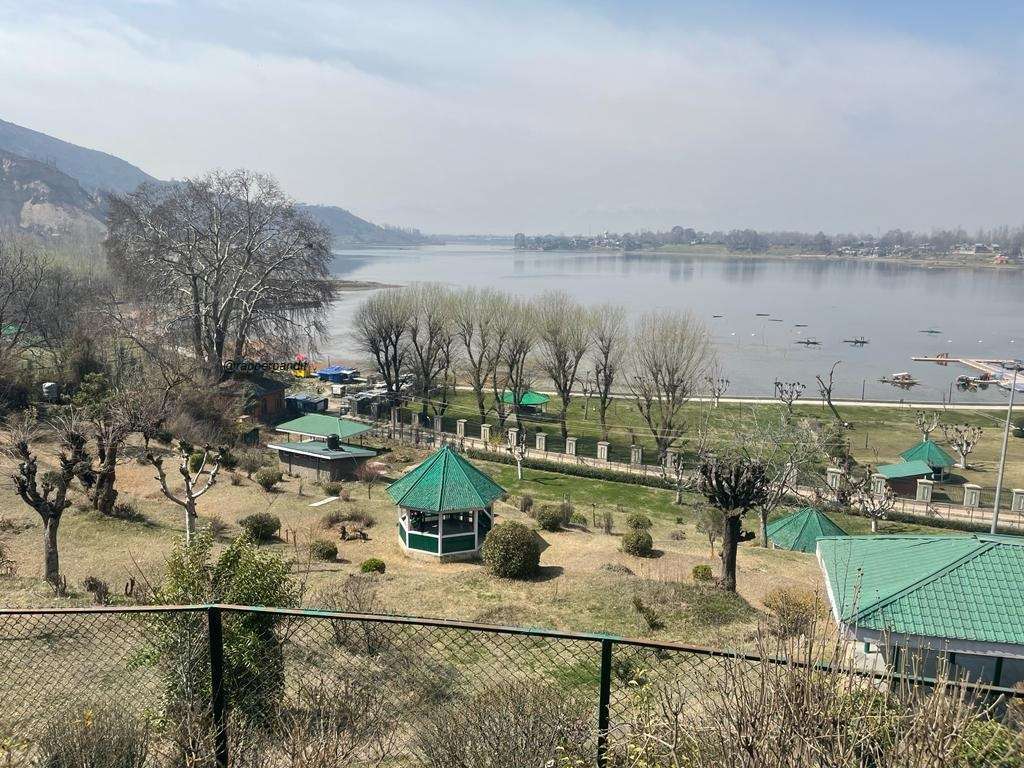
Significance- The Temple is believed to be constructed in 8th or 9th Century by Avantiverman or Shankaraverman. Adjacent to it is the great Manasbal lake which has various amenities from a great outing. The lake is considered to be the gem of all Lakes Lush with Lotuses, Birds and aquatic life. 40kms, 1 hour drive is Wullar Lake- Asias Largest Fresh water lake.
Day-3 : Martand Sun Temple, Mattan Temple, Avantipora Temple
Club with visit to Pampore Saffron FieldsMartand Sun Temple : 71kms from Dal Lake Srinagar, 8 kms from Anantnag.
Google Map: https://goo.gl/maps/eRrHTJffRkAeAkNu7
Significance: 1200 Year Old Temple, Built by the great Lalitaditya Muktapida in 8th Century AD., this monumental temple of extreme architecture, dedicated to Sun god, and various dieties like Maa Ganga, Yamuna Saraswati , Bhagvan Vishnu and Shiva was destroyed by Sikandar Shah Miri. Locals still call it Pandav Lairi (पांडव लअरि) , believing that the gaint stones were assembled by Pandavas during exile and later Lalitaditya Muktapida rebuilt it. Zoom in to see various Carvings
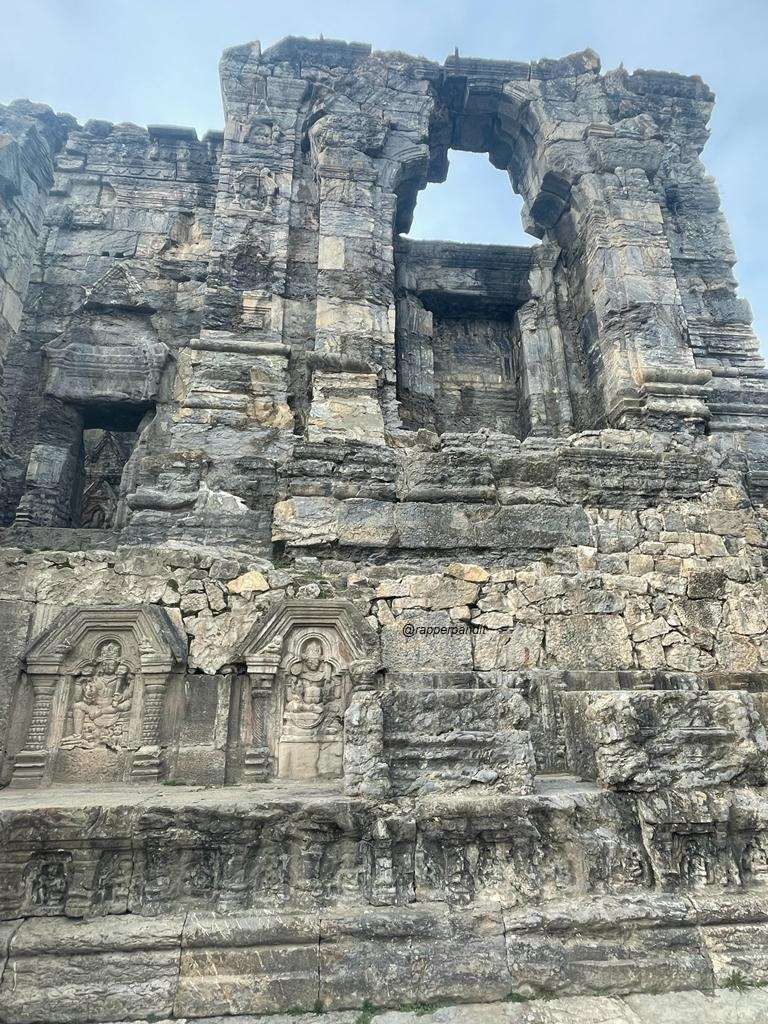
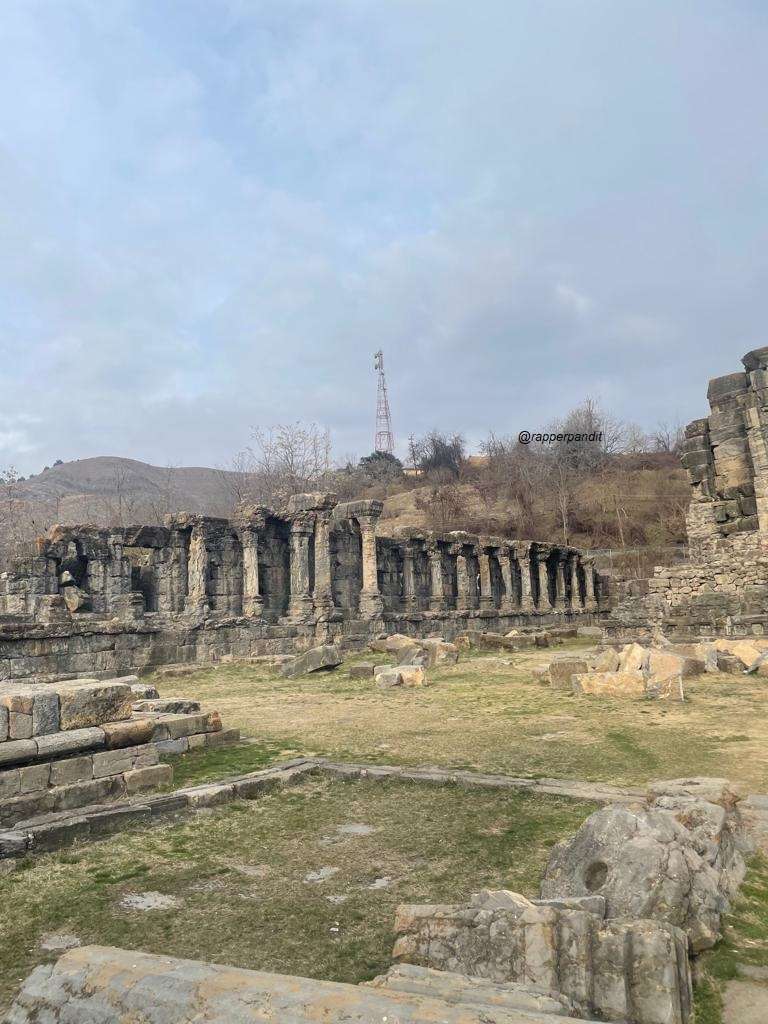
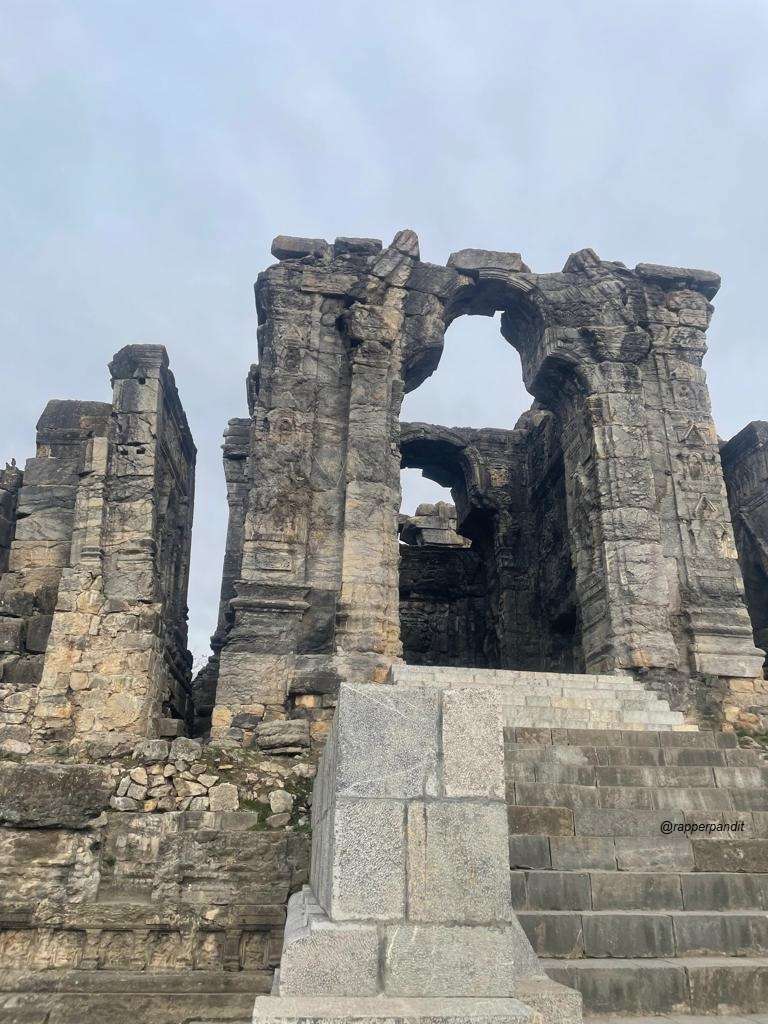
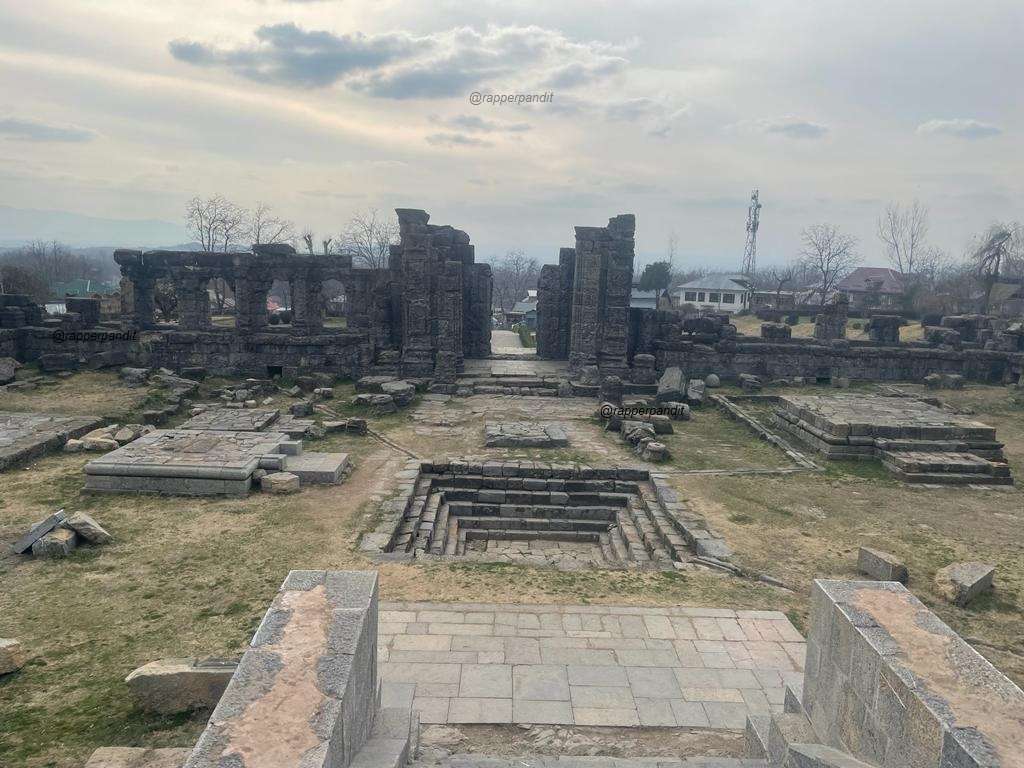

Mattan Temple: Just 3.5km from Martan Sun Temple above.
Google Map- https://goo.gl/maps/DZWEdkq5wF3LfUKVA
Significance: Mattan Temple Or Sri Martand Temple is also dedicated to Sun God and a very important pilgrimage for Kashmiri Hindus. It is especially special for the Fresh water spring which has bountiful of Fish that are not allowed to be killed or even to be fed. In the same Complex is Gurdwara Mattan Sahib, believed to be visited by Guru Nanak Dev ji during third Udasi. Hindus from Mattan only had gone to Guru Teg bahadur to save them from atrocities.


Avantipora Avantishwara Temple : 35kms from Martand Sun Temple Towards Gulmarg
Google: https://goo.gl/maps/js13EgC2PJifimLq9
Significance : This 1100 years old temple, Also Known as Avantishwara or AvantiSwami Temple, is dedicated to Bhagwan Shiva is an Excellence of Temple Architechure. This 9th Century Temple is built by King Avantivarmana in 9th Century


Day-4 : Shiva Temple Gulmarg and Datta Temple and Magical Matka of Bheema, Uri-Baramulla
Mohinishwar Shivalaya Shiv Mandir Gulmarg: 80 kms from Avantipora Temple mentioned above, this Temple is located in the Heart of Gulmarg at a small hilltop.
Google Map: https://goo.gl/maps/nmzBDcsxB5cTnsig9
Significance: Not Many Tourists Know that the Real Name of GulMarg is Gauri Marg– गौरी मार्ग – The Path on which Maa Gauri walked, and there is an Ancient Temple of Shiva at hill top in Gulmarg worshipped by Maa Gauri herself.


Datta Temple & Magical Matka of Bheema Situated 70kms from Gulmarg in Uri, Baramulla.
Google Map: https://goo.gl/maps/p6Vx4cJetHkTBWbc6
Significance: Baramulla is derived from VarahaMoola (Boar’s Molar). Locals still Call Baramulla as Varmul (वरमुल) . This is the place where it is believed that the Varah Avatar inserted its Molar into surrounding Hills of Satisar Lake to Drain out the Waters. It was important to expose demon Jalodbhava of Satisar (who couldn’t be defeated inside water) to Tusks to Take out Bhudevi immersed in Eternal Waters. It is believed Stisar was source of River Saraswati, and after Satisar Drained off, River Saraswati Started Drying up and in trace to go nearer to the source as the river was driving up in course many Saraswat Brahmins added to Kashmir.
In Uri in Baramulla you will find Datta Temple built by the Pandavas during exile and has a Magical Matka of Bheema in which Water Level never Recedes how so much water you take out of it (Read the complete Story by zooming on the picture). Originally believed built by Pandavas, this temple dedicated to Lord Vishnu was desecrated in 1947 and many idols stolen/broken.


OTHER MISCELLANEOUS EXPLORATIONS
ShankarGaurishvara Temple (शंकर-गौरीश्वर ) : 35 kms from Dal- Lake Srinagar NH1A, Pattan, Baramulla
Google Map: https://goo.gl/maps/RzAGdztiNe7r8ojJ7
Significance: Dedicated to Bhagwan Shiva, Built by King Shankarvarman (883 to 902 AD), of the Utpala Dynasty. The 9 circular holes in three rows might have something to do with Magnetic Levitation of प्राण प्रतिष्ठित मूर्ति . Pattan was the capital of Empire of King Shankarvarman . He was the son of King Avantivarman, who built the Avantiswami Temple mentioned above.
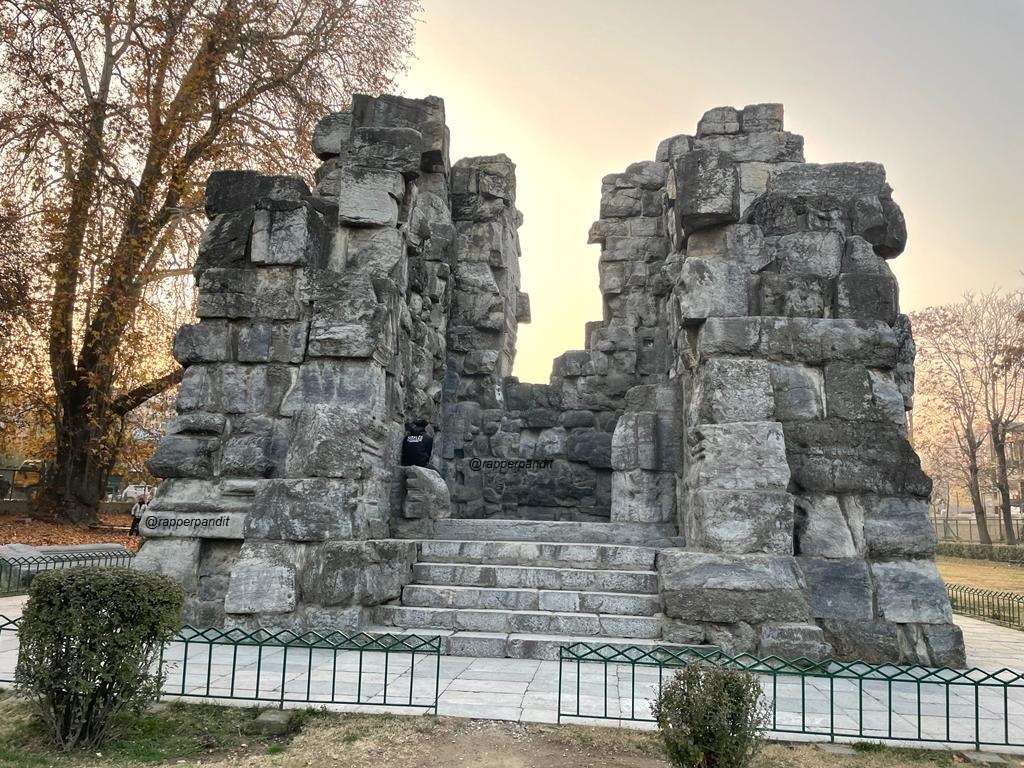
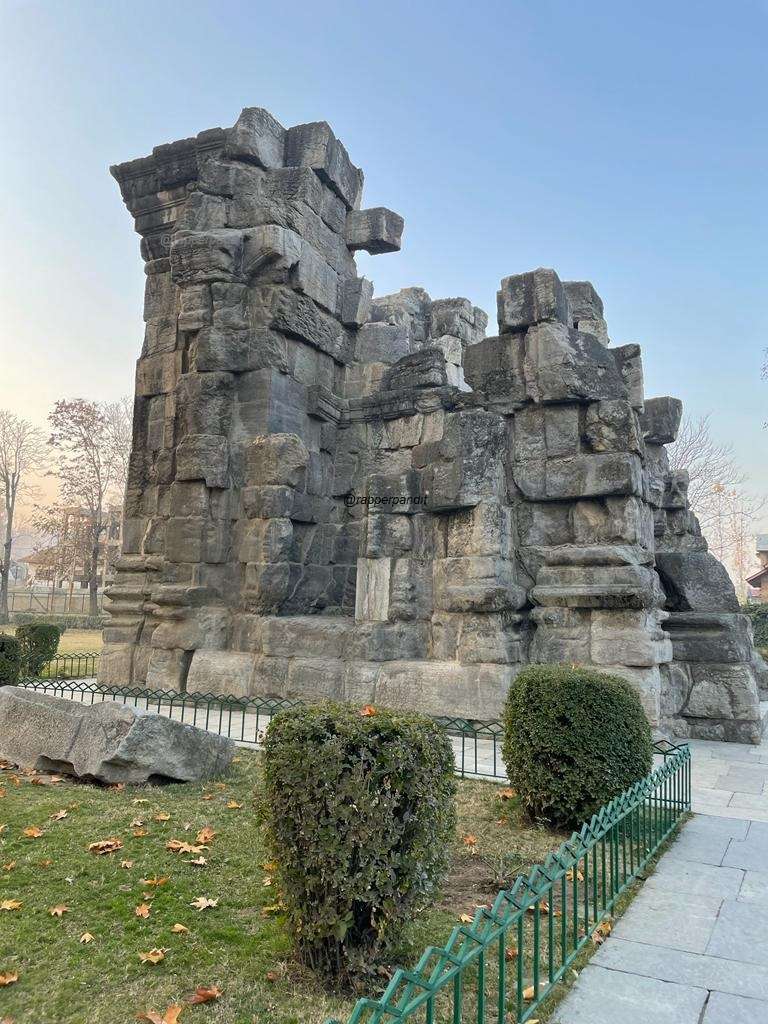
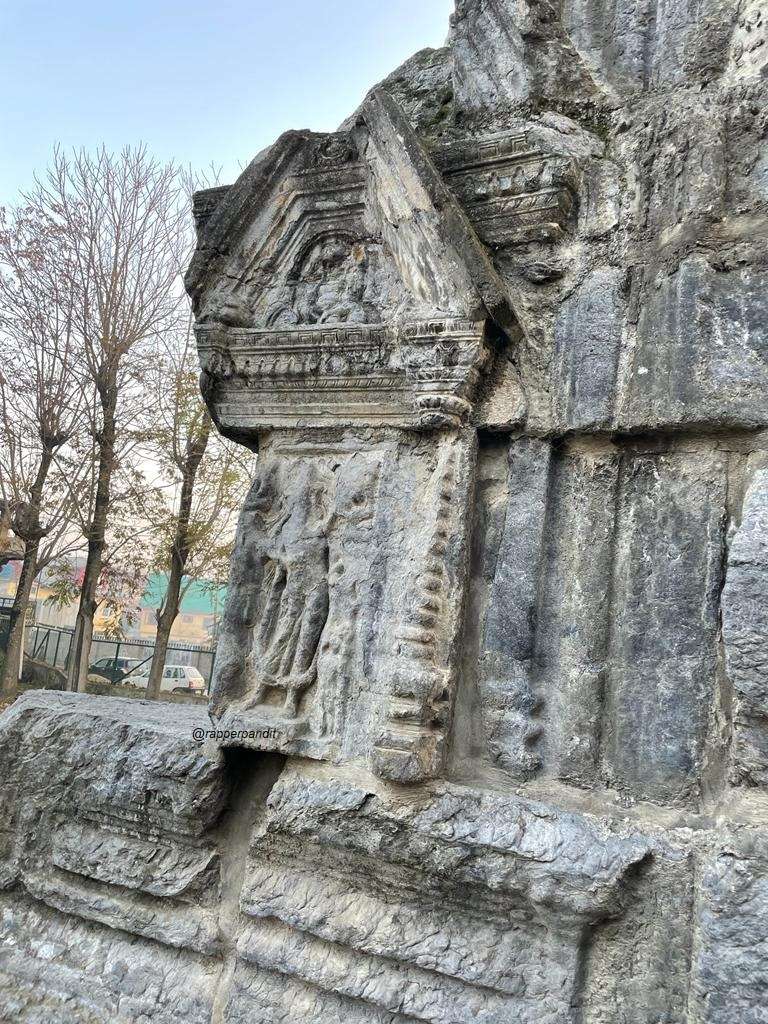


Sugandhesha Temple, Pattan (सुगंधेश ) : 33 kms from Dal- Lake , 10kms from ShankarGaurishvara Temple
Google Map: https://goo.gl/maps/vpQqAVaUUXoyTCkU9
Significance: Built by the Queen Sugandha , wife of King Shankarvarman, the temple is dedicated to Sugandhesh i.e. the ईश of Sugandha (ie Shiva or Vishnu), the grand temple stands in ruins. The Architecture is Amazing.
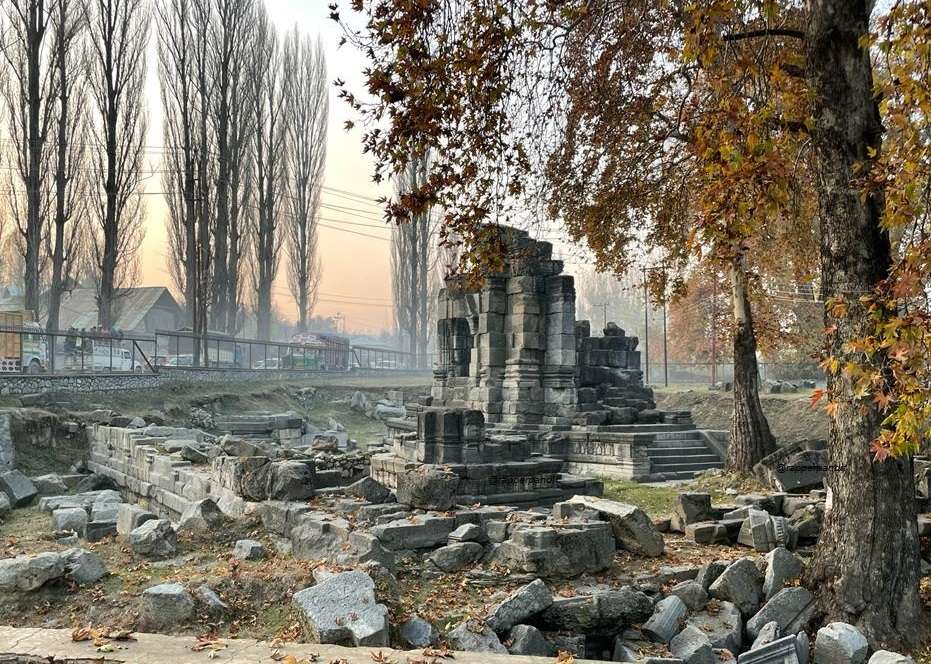


Thank you for Reading upto Here, hope it could rekindle your thought process while visiting Kashmir.
There are many-many more temples unexplored and still surviving in Kashmir in Good, Bad and Pathetic Conditions. Almost all the Temples in good condition are mostly due to being under the Control of Central Security forces Camp
Do share your feedback.Avantipora, Avantivarman, Chakreshvar, Gulmarg, Hari parbat, Hari Parvat, hinduism, Kashmir History, KHeer bhavani, Ksheer Bhavani, Lalitaditya, Mansbal, Martand Sun Temple, Mattan, Meaning of Kashmir, Origin of word Kashmir, Ragnya Devi, Sanatan dharma, Shankaracharya, Shankaracharya temple Kashmir, Sri yantra, Tullamulla, Zyestha devi -
Guru Nanak Dev ji & Vedas
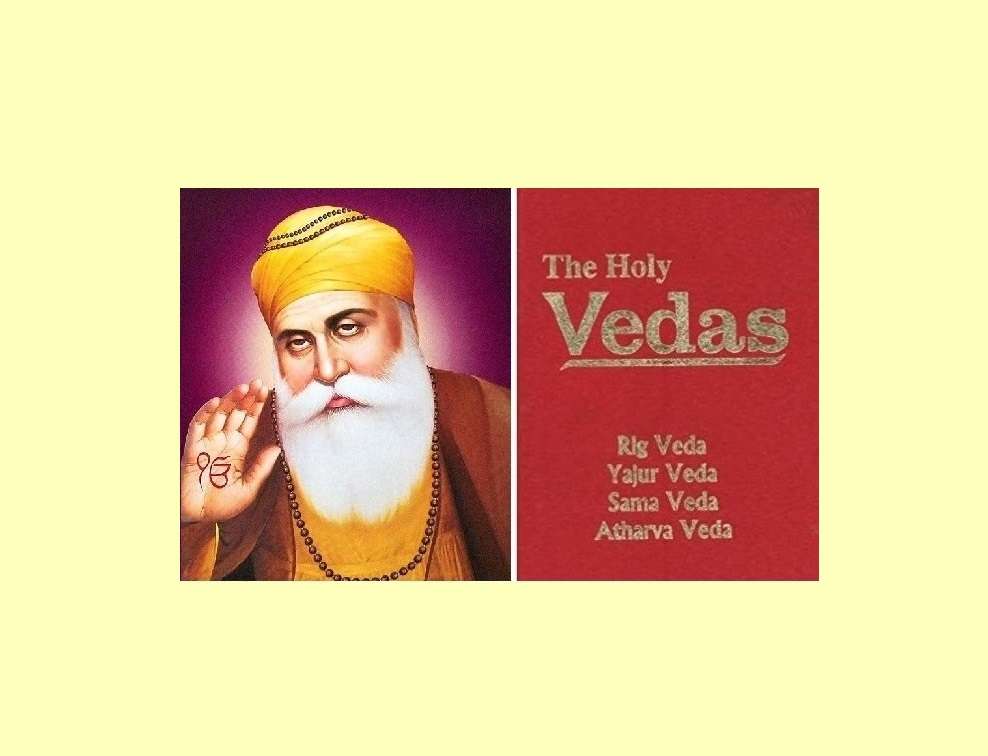
Once I heard a young Sikh say :
“We don’t believe in writings of Dasam Granth , we believe only in Holy Guru Granth Sahib ji“
Guru Granth Sahib ji is considered to be the Eternal Guru of Sikhs-the 11th Guru. GuruGranthSahib ji was composed by 6 Sikh Gurus, 15 Bhagats, 11 Bhatts, 4 GurSikhs. Here we will focus only on Sikh Gurus with focus on Guru Nanak Dev ji
Today we will go thru the various Angs of Holy Guru Granth Sahib ji to understand the theme of Guru Granth Sahib ji .
The Connection of Holy Guru Nanank Devi ji & Vedas has been hidden deliberately from ages to create a gap between Hindus and Sikhs. The Learned Sikhs know it very well, but many choose to not highlight it. Please read slowly till end, because when you reach at end you will have a completely different understanding of Sikhism.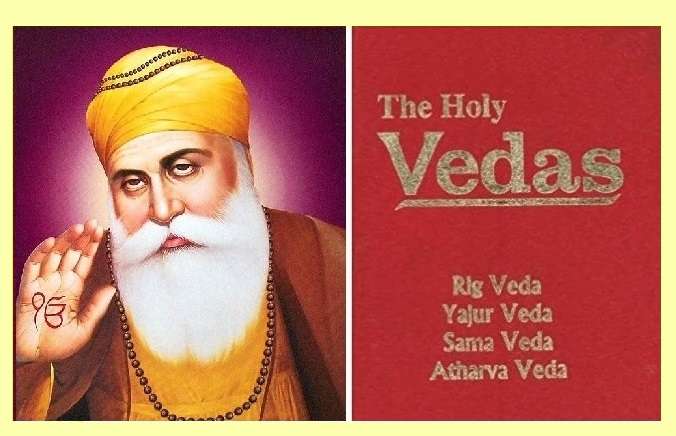
Wherever I see, I see Lord as the “Union of Shiva & Shakti”
The Guru’s Word is the Wisdom of Vedas
The Guru is Shiva, Vishnu & Brahma , Guru is Parvati & Laksmi
~Guru Granth Sahib:Ang 2 & 21 by Guru Nanak Dev ji.
The God Killed Sahastra-Bahu, Madhu Ketabh,
He seized Hiranyakashipu and Tore him with his Nails
The Demons Jaraa Sandh & Kal Yavan were Destroyed
Rakt Beej and Kaal-Neimi were annihilated By Slaying the Demons,
The Lord Saved his Saints.
GGSJ – Ang 224 : by Guru Nanak Dev ji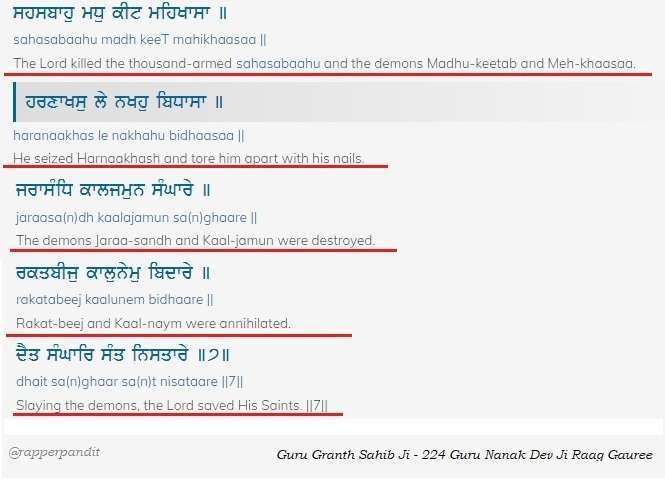
The Lord himself Misleads People (Thru Maya)
Evil Hiranyakashipu committed Evil Deeds,
He Bestowed his Mercy, and Saved Prahlaad
Ravan was Deluded, Foolish and unwise.
Srilanka was Plundered and he lost his head.
GGSJ – Ang 224 : by Guru Nanak Dev ji.
The Four Vedas, the Four Sources of Creation,
The Countries, continents and all the worlds
Have all come from the One world of the Lord !
GGSJ– Ang 432 : by Guru Nanak Dev ji.
He Created the Four Vedas, the Four Sources of Creation ,
and the Four Yugas (Satya, Treta, Dwapar, Kali)
thru each Yuga, he himself has been the Yogi, the Pandit
The human has wandered thru 8.4million incarnations
GGSJ – Ang 432 : by Guru Nanak Dev ji.
The Vedas say, and the words of Rishi Vyaasa tell us,
That the silent Sages, he Servant of the Lord, practicing austerity, keep remembering his Supreme name (God) ,
You are all pervading thru Aakasha, Pataal , and Tribhuvan
GGSJ – Ang 57 & 62 : by Guru Nanak Dev ji.

The merits of reciting Smritis, Shastraas, and the Vedas Yoga,
Siddhi, Pleasures, all these come by surrendering in the Name of Lord and Chating Har Har
The Simirites , the Puraanas and Four Vedas and the Six Shastraas Meditate on Him
Wonderful is the Sound of Naad,
Wonderful is the Knowledge of Vedas
GGSJ – Ang 202 & 224 :by Guru Arjan Dev ji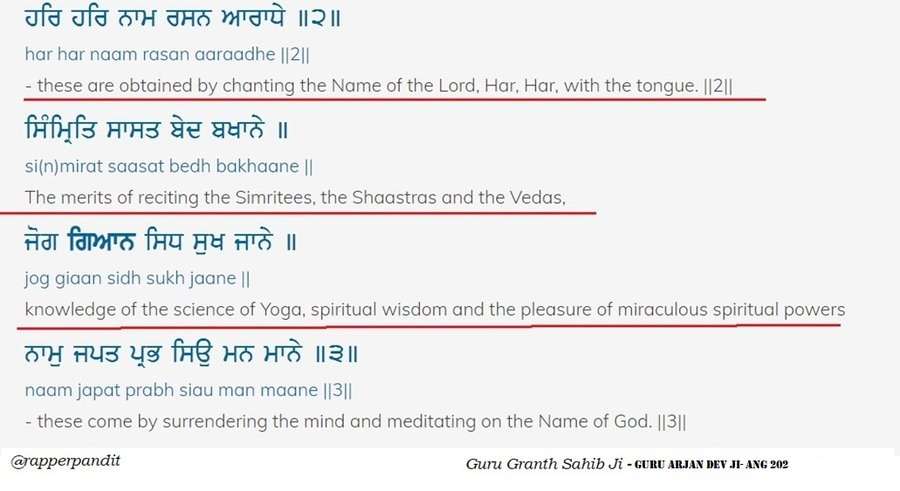


I bow to the Lord of the World, to His Word, to Brahma the Creator
GGSJ – Ang 202 & 224 :by Guru Arjan Dev ji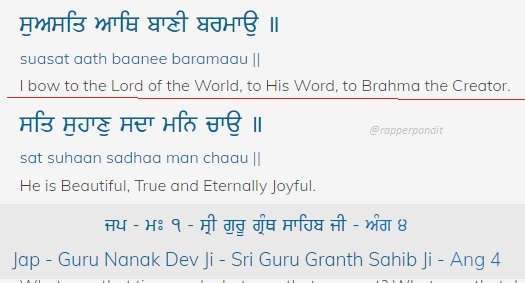
The One Divine Mother, conceived and gave Birth to the three deities.
One, the Creator of the World , One the Sustainer, and One the Destroyer
GGSJ – Ang 7 :by Guru Nanak Dev ji
The Lord, the Primal Being is immaculate and Pure
GGSJ – Ang 202 & 224 :by Guru Arjan Dev ji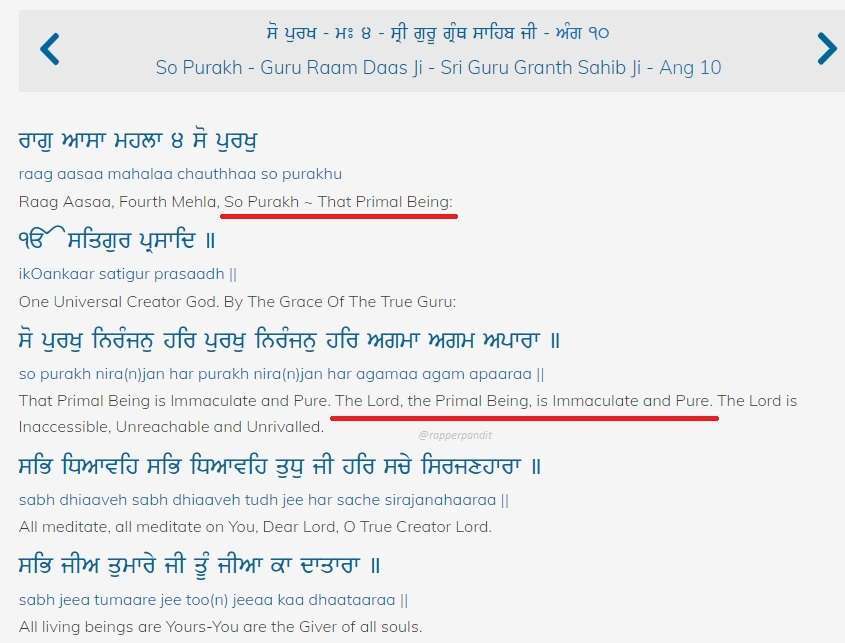
Ik Omkar (Ongkar) Sati Namu, Karta Purkhu, NirBhu, NirVairu,
Akaal Murti, Ajooni Saimbhu, Gur Prasadi
Translation:
One Omkar is the True Name, of the All Prevading Purkhu in Action, which is without Fear, without Jealousy,
Beyond time Muhurat, Doesnt have a Yoni (or Form) , is Savyambhu (Self Born), is a Gift of an Enlighted Guru
~The Mool Mantra of Guru Granth Sahib ji
Translation by Renowned Sikh Author Prof Sahib Singh, Bhupendra Singh BhaiKhel
He has Filled All, He is Radiant, Bodiless. Invulnerable, devoid of sins, Pure, Untouched by evil,
He the seer, thinker, all Prevading, self-existent has duly distributed through endless years the objects according to their natures
~Yajurveda 40.8 (IshaUpanishad)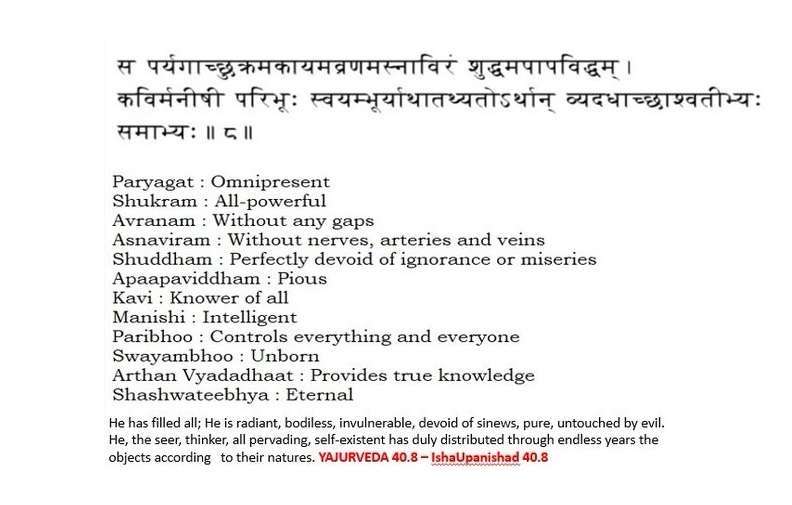
Some People May Say that Ongkara and Omkara are Different.
Well I am quoting from the famous Sikh Website https://www.sikhiwiki.org/index.php/Ek_Onkar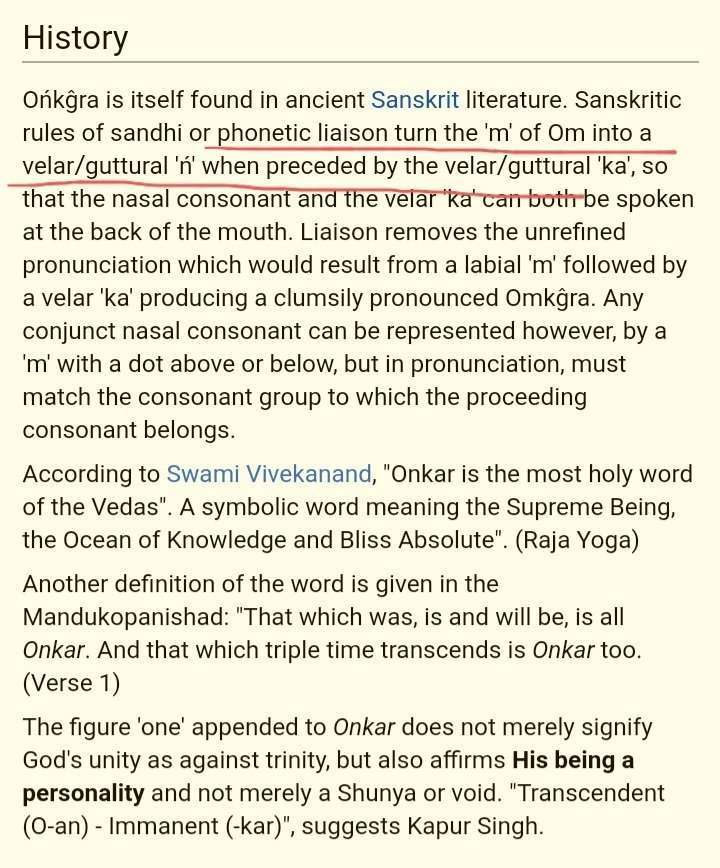
But some may rightly ask, what relation Guru Nanak Devi ji and Sanskrit or Vedic Studies have. Let’s try to Explore.
The Name of Parents of Guru Nanak Dev ji were Kalyan Chand Das Bedi & Mata Tripta . Check the Chart below.
Bedi, Trehan, Bhalla, Sodhi were Surnames of 10 revered Gurus, all belonging to the Khatri or Kshatriya Clan. Bedi Or Vedi surname was used by people who mastered atleast 1 Veda (just like Dvivedi, Trivedi, Chaturvedi surnames). The Sharda Lipi was very popular till in North from Kashmir to Varanasi. It is from this Sharda Lipi Mahajani Originates which Gave shape to Gurumukhi for GuruGranth Sahib ji at the Time of Guru Angad.
It is believed that the Bedi lineage of Guru Nanak ji traces its lineage to Bhagwan Ram as descendants of Kusha.
This i am not telling. This is mentioned in Dasam Granth by Guru Gobind Singh ji Mahraj. It is for you to believe or not.
Descendants of Lava, after handing over the kingdom, went to the forest, and the Bedis (descendants of Kusha) began to rule.
Amrit Keertan – Guru Gobind Singh Ji – Dasam Bani -Panna 54
Conclusion: By now i have not put any of my interpretation. Everthing is verbatim from the Holy Guru Granth Sahib ji. Guru Nanak Dev ji in his own words has revered the Trinity (Brahma, Vishnu & Mahesha) and the Supreme adiShakti who created them. Guru Granth Sahib ji holds the Vedas in high reverence, but the Question is who is the Ultimate Lord Guru Nanak Dev ji is focusing upon?
It’s none other that Akaal Purukh (Akaal Purusha), the all pervading Brahm ब्रह्म , the universal Consciousness, represented by the sound of OM. All the Vedas Glorify that Supreme Timeless Purusha- the all pervading Brahm in the form of Pure Consciousness, who coupled with Prakriti (Matter/Energy) is the basis of the Creation of Universe as we see it
Hinduism is Collection of mainly 6 Sampradayas worshipping- Shakti, Vishnu, Shiva , Ganesha, Surya & Agni– thats why unifier adiShankaracharaya was called षनमत्स्थापनाचार्य . The Word Sikh Originates from the Words Shishya. Sikhs are also a Sampraday, a Panth like other major Panths of Sanatan Dharma. Hindus, Sikhs, Jains, Buddhists are all branches of the same Sanatan Dharma, Don’t be divided.Credits:
Guru Granth Sahib ji translation : http://www.sikhitothemax.org
Translation of Ongkar : https://www.sikhiwiki.org/index.php/Ek_Onkar
Translation of Mool Mantra: Prof. Sahib Singh, Bhupendra Singh Bhaikhel -
Srimad Bhagavad Gita 1.2

Srimad Bhagavad Gita 1.2 – A detailed explanation – Context, Psychological, Historical
Sanjaya Replies to Dhritarashtra, the scene when Duryodhana sees Magnificent powerful Military array of Pandavas.
The Vyuh (specific Military Array) on Day-1 Called Vajra Vyuh was created by Arjuna from the Pandava Side and SarvatoMukhi Dand Vyuh was created by Bheeshma on the Kaurva side. -
Srimad Bhagavad Gita 1.1
Srimad Bhagavad Gita 1.1 – A detailed explanation – Context, Psychological, Historical
Srimad Bhagavad Gita- The Song of the God verse 1.1 – detailed explanation -
Lost in Avantika City- Striving for Kannada

The Great Bharatvarsha (India) more than 19500 languages are spoken across the country. There are 22 National Languages of India, which can also be seen on the Currency Notes: Assamese, Bengali, Bodo, Dogri, Gujarati, Hindi, Kannada, Kashmiri, Konkani, Maithili, Malayalam, Manipuri, Marathi, Nepali, Odia, Punjabi, Sanskrit, Santali, Sindhi, Tamil, Telugu, Urdu.
Out of these 22 Languages, how many does each of us know? Not Many.
Mostly because it is not taught to us in the School curriculum or we find it too difficult to learn. While Indian kids want to Learn German, French or Spanish, which is good, but they don’t learn the native languages of other areas in the country. Imagine how beautiful and connecting it will be for a Delhi person to know Kannada or Tamil Or a Tamil Person to Know Punjabi or Maithili, or a Gujrati Person to know Assamese or Bengali and An Assamese Person to know Marathi. But why is it important at all?
Language removes all barriers and has a power to Turn Country into a Nation. That will bring the real unification of North South East and West. But the Problem is How to Learn Languages easily?
There are Four Essential Rules to Learn a Language very easily:
1. Speaking a Language is the Best Way to Learn it. Just like a Child Learns.
2. Don’t care about the Script, the Sound matters
3. You don’t need to Learn entire Vocabulary and Grammar- we don’t teach Grammar to children.
4. Just a Few Sentences covering Daily Requirements are sufficient to Connect.So, with the above thought process, let’s begin this Journey. We’ll Cover 12 Major Languages out of 22 National Languages. Kannada, Malayalam, Tamil, Telugu, Marathi, Sanskrit, Odia, Punjabi, Assamese, Bengali, Gujarati, Maithili
Today in this Session we will Learn about KANNADA, the language predominant in Karnataka, and helpful for other place people living in Bengaluru.
The Story Starts Like this: Gautam, a young boy from Delhi, is lost in a remote Avantika City in Karnataka, where people speak only Kannada. Gautam is alone and hungry and thirsty. A local kind person Ravi sees him and approaches him for help. Let’s see what they speak.

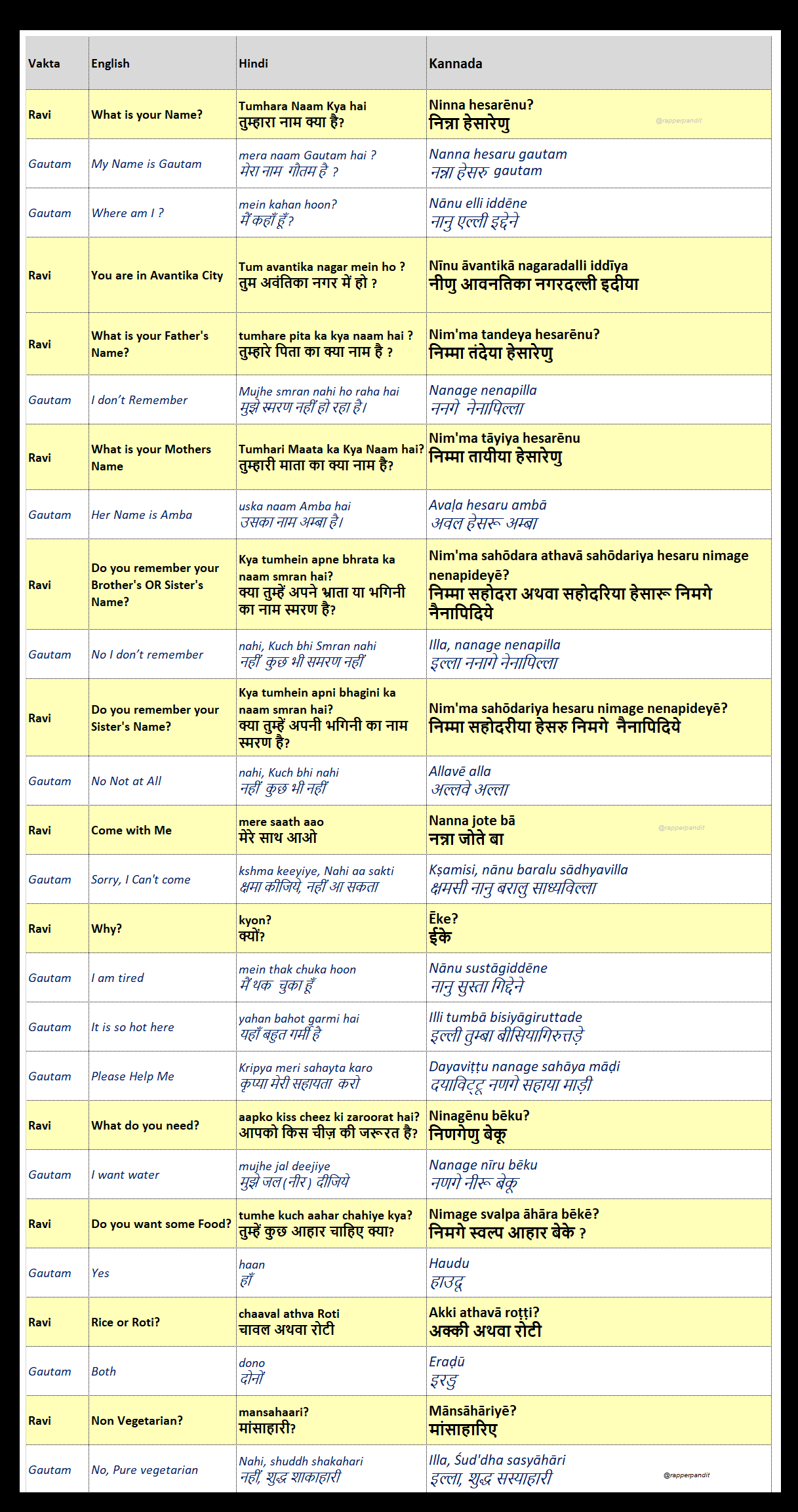
After having food. Gautam thanks Ravi. But Ravi sees an opportunity to Serve the young boy and earn पुण्य Punya. So he asks further.

Just read the Above Discourse 10 times. You will understand the basis of this Language.
I have tried my best to preserve the translation and pronunciation, however, if any learned reader feels any corrections, i will be more than happy to incorporate the changes. Please provide your feedback in the Comments section.
-
How Indian Maths Changed the World – Number System

All the Scientific Development in the West from 13th Century onwards owes its presence to the beautiful 10 digits 0,1,2,3,4,5,6,7,8,9 and the arithmetic operation rules on them, followed by a flood of discoveries in the fields of Trigonometry, Calculus, Algebra and various Theorems & Equations. But How did Europe come out of the dark ages suddenly and how so many mathematical discoveries suddenly erupted from 13th Century onwards is little explored and may be knowingly. The Roman Number Operations were so Tedious that what seems a simple multiplication today, can take days to be solved. Today we will understand the untold truth of this magnanimous contribution of Indian Maths in the field of Modern Number System and its operations to the West from Horses Mouth.
FIBONACCI, the Famous 13th Century Mathematician’s name, was ‘Leonardo Pisano’ . He is credited to Changing Roman Number System to Modern Number System in Europe and revolutionizing the World. But is it completely or partially true or not true at all. Let’s Start
Fibonacci in his Book ‘Liber Abaci’ Translated by L.E. Sigler writes in the PROLOGUE :
“In it I present a Full instructions on Numbers close to the ‘method of the Indians’ whose Outstanding Method I chose for the Science” Read this again and again, slowly, till you absorb it.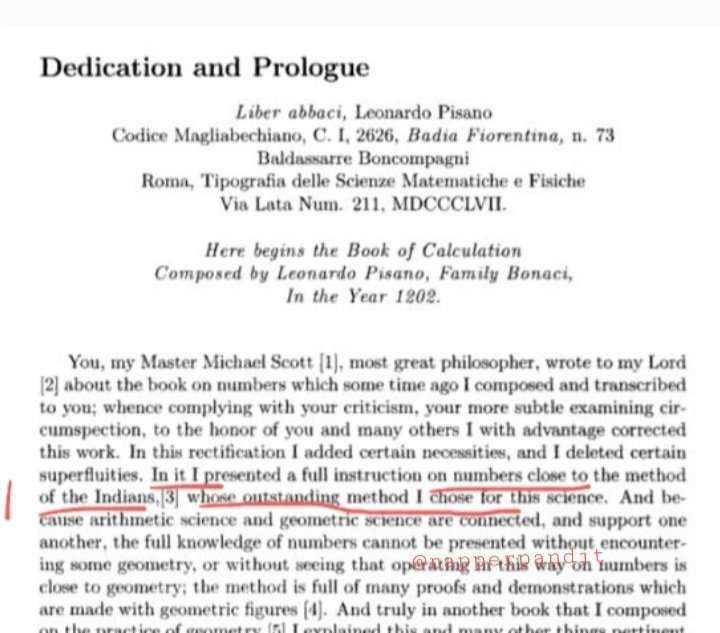
Image-1 from Fibonacci’s book Liber Abbaci In the Preface Fibonacci Tells that he has travelled wide and studied various systems, but “He has found ‘Hindu Number System’ and its methods of calculation Superior to all Other calculations” . Now remember, a particular section of Academicians have continuously been telling you Arabic Numerals or Hindu-Arabic Number system instead of pure Hindu Number System
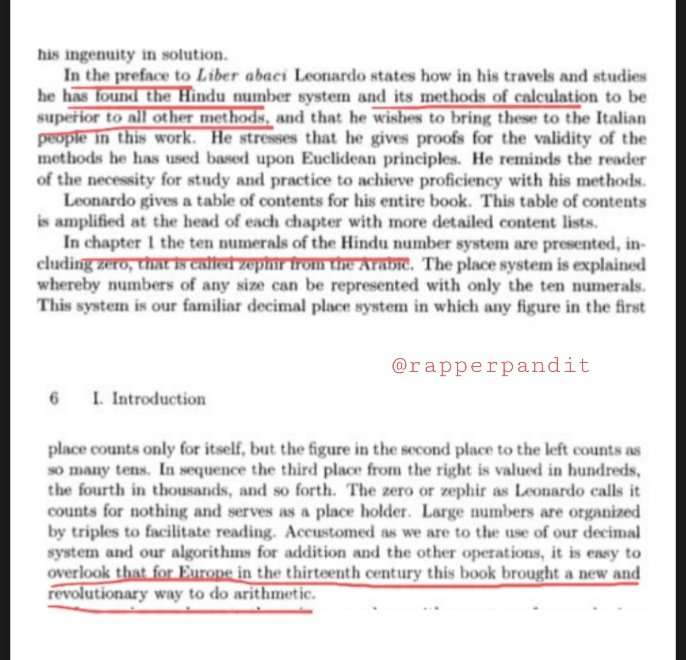
Image-2 from Fibonacci’s book Liber Abbaci “My Father was a public official away from our homeland in the Bugia(Algeria) customshouse established for the Pisan (italian) merchants who frequently gathered there…. There from a marvelous instruction in the art of nin Indian Figures, the introduction and knowledge of the art please me so much above all else.
Fibonacci goes on to mention that he learnt (Indian figs. and arithmetic operations) from the Egyptians, Syrians, Greeks and those from Sicily and Provence. This clearly shows that these countries were already taking advantage of the Indian Number System for Trade and Commerce. But this no one tells. Fibonacci is clear that European methods are almost an Error Compared to (advanced) Indian Methods. Therefore he strictly embraced the Indian Method and was attentive to learning it.
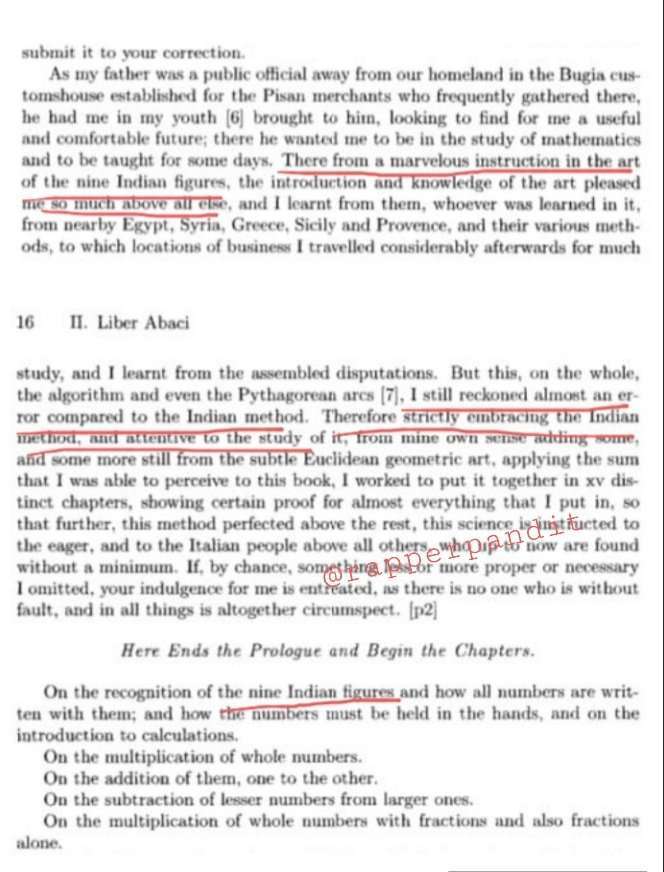
Image-3 from Fibonacci’s book Liber Abbaci Check the Map Below you can understand Fibonacci’s Bigha(Algeria) Location and the route to India via Arab leading to Knowledge transfer from cradle of civilization Bharatvarsha.

Image-4 Map of Ancient Trade routes and Knowledge Routes Fibonacci’s (Leonardo’s) intention was to introduce Hindu Number System and it’s operations to Italian people….. It was Leonardo’s Purpose to replace Roman Numerals not only among Scientists, but in commerce and among common people. This Knowledge spread from Mediterranean World to Germany
For next 3 centuries (13th to 16th Century) this book, Liber Abaci by Fibonacci (Leonardo Pisano) was was Taught in Europe which Later led to development of Science and Industrial revolution.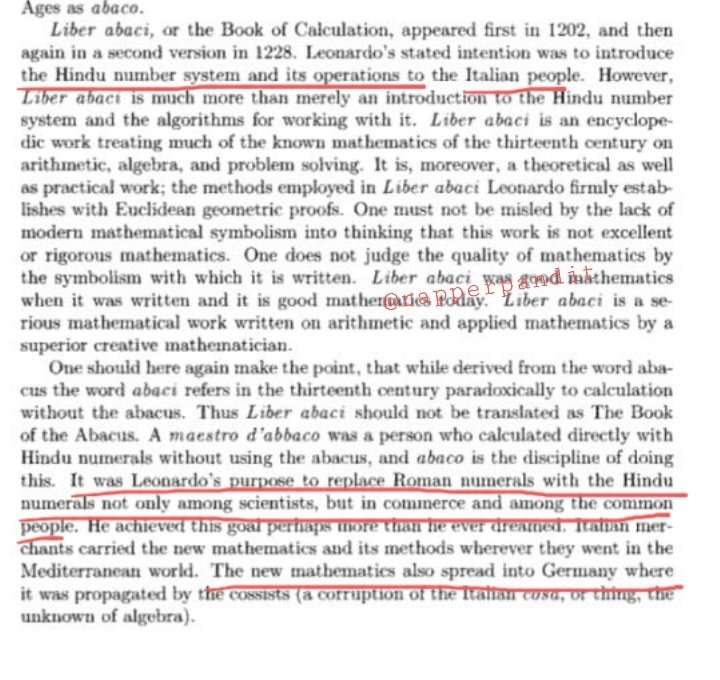
Image-5 from Fibonacci’s book Liber Abbaci in the Starting Chapter 1 Itself, Fibonacci Refers The Nine Indian Figures are 9 8 7 6 5 4 3 2 1 and Zephir
It is clear that due to Left to Right sequence of numbers he learnt it from Arab traders but point to note that Everywhere he everywhere refers “Hindu Number System” Or “Indian Number System.”

Image-6 from Fibonacci’s book Liber Abbaci While above pages are authentic English Translation of Liber Abaci by L.E. Sigler, Let’s see the Original Work showing 9 digits
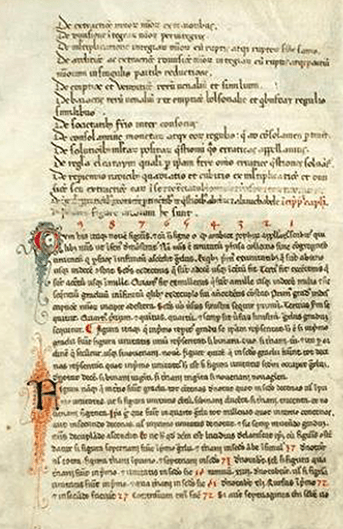
Credits: Mathematical Association of America website https://www.maa.org/ Arabs are Far More Honest in admitting it. See what the Govt Website of Govt owned Saudi Aramco Says: Mislabeled for several Centuries in the West as Arabic Numerals, the decimal system was conceived in India and Transmitted to the middle east even before the rise of Islam.

Image-7 from Saudi Aramco (Govt Owned) Website aramcoworld.com What we famously call as Fibonacci Numbers are actually Hemachandra numbers. But the Great 11th Century Jain Scholar and PolyMath Hemachandra in Turn credits it to great Rishi Pingala. Such were the ancient sampradaya of Sanatan Dharma. No hatred, No Jealousy.
I am just leaving you here with a Chronology and of known major Mathematicians world over. Read slowly and carefully and you will be amazed to see the contribution of Indian Mathematicians that Changed the World.


Image-8 Chronology of main known Mathematicians of the world by @rapperpandit The onus is on you, on all of us to spread the Truth
-
From Urdu & Hindustani to Hindi & Sanskrit

Article 351 : is the Constitutional Directive to the Government for Development of Hindi Language. But that Hindi Language has to be Pure- a common language assimilating almost all native languages of India from Telugu, Malayalam, Tamil , Kannada, Odia, Gujrati, Bengali, Marathi, Bhojpuri, Maithali etc etc. in one thread.
You will find that most of the native Indian languages are very close to Samskrit / Pure Hindi, but our native languages are very alien to Arabic, Persian , Urdu Dialect. Hence Hindi Language in Pure Form has a Power to Unite the Whole Country in One Thread. So, Let’s start.In Just 199 Words we will be able to migrate maximum used vocabulary of Urdu/Hindustani to Pure Hindi which is very close to Samskrit. Teach these words to the upcoming generation to save ancient culture. While you read it, recall what was it called in your native language too, and you will find lots of Similarities.
RELATION रिश्ता= संबंध
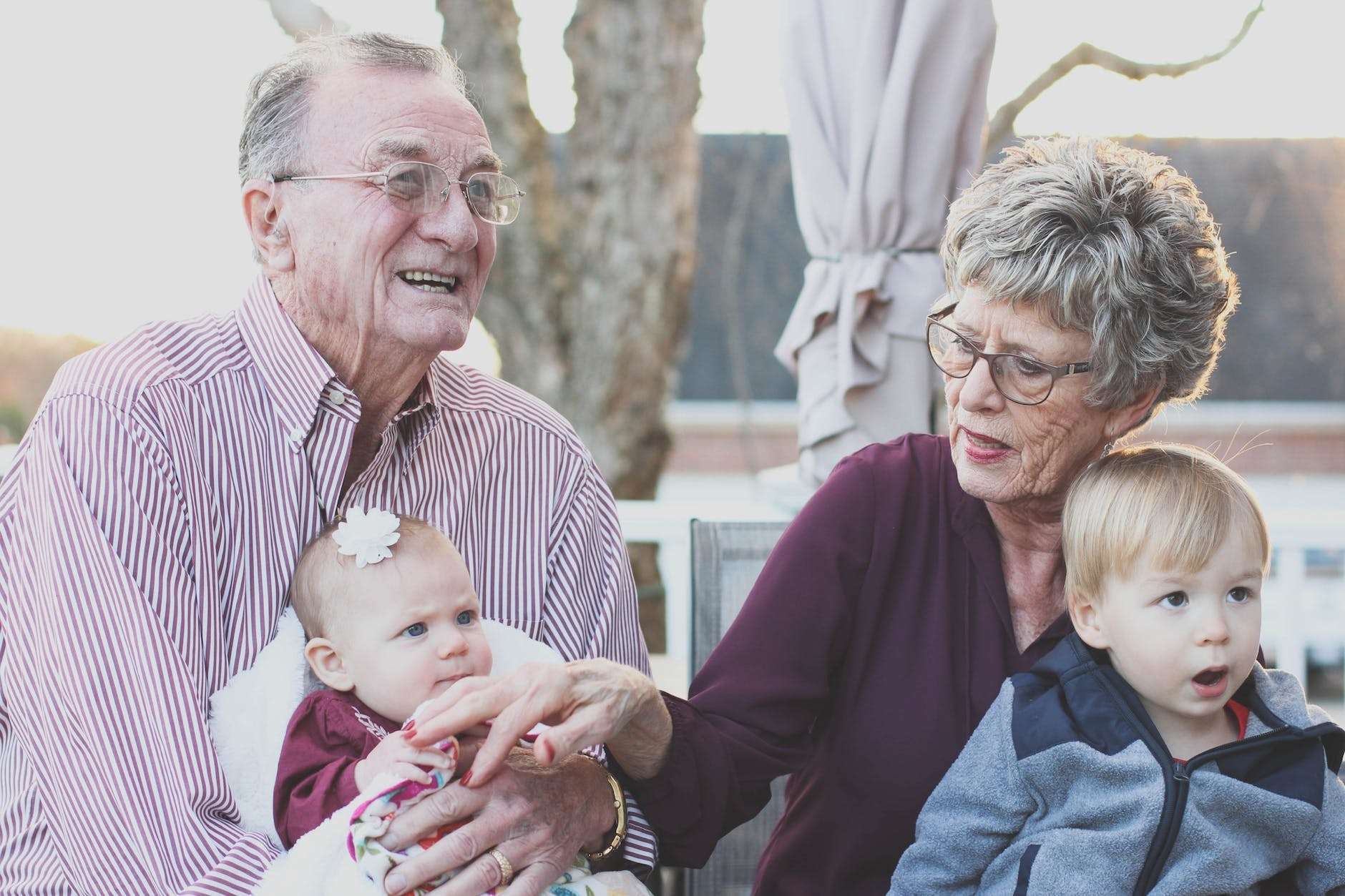
- नाना-मातामह , नानी-मातामही
- दादा-पितामह , दादी-पितामही
- चाचा-पितृव्य
- मामा-मातुल
- पोता-पौत्र , पोती-पौत्री
- नाती-दौहित्र , नातिन-दौहित्री
- साला/साली-श्याल/श्याली
- भाई-भ्राता
- बहन-भगिनी
- दोस्त – सखा / सखी/ मित्र
- बाप – पिता / जनक
FLOWERS : फूल = पुष्प
- पुष्प
- Rose- जपावा, पाटल
- Daisy-मातृ
- MariGold गेंदा-सेवन्तिका
- Lily-नलिनी
- Water Lily-नीलकमल
- Lotus-कमल
- Mushroom-छत्रक
- Tulip-कंदपुष्प
- Jasmine चमेली- रेवती, मल्लि
THINGS: चीज़ = वस्तु / पदार्थ
- Metal – धातु
- Diamond-वज्र
- Copper – ताम्र
- Gold -स्वर्ण
- Silver-रजत
- Bronze – कांस्य
- Iron-लोह
- Wood- काष्ठ
- Coal- अङ्गार
- Acid. अम्ल
- Base/Alkali-क्षार
OFFICES दफ्तर = कार्यालय
- नक्शा-मानचित्र
- इमारत-भवन
- Syllabus -पाठ्यक्रम
- University-विश्वविद्यालय
- Bachelor Degree-स्नातक
- हथियार-शस्त्र
- सिपाही-सैनिक
- दफ्तर-कार्यालय
- चौकीदार-प्रहरी
- जज-न्यायाधीश
- कैदी-बन्दि
- जेल-कारागार
BIRDS परिंदा = पक्षी
- तोता – शुक
- मोर-मयूर
- कबूतर-कपोत
- बाज़- गरुड़ (eagle/hawk)
- गृध्र – Vulture
- मैना-सरिका
- चमगादड़-जतुका
- हंस-मराल
- कौआ-काक
- कोयल-कोकिल
ANIMAL जानवर=पशु
- घोड़ा-अश्व
- चूहा-मूषक
- बैल-वृषभ
- गाय- गो, धेनु
- बिल्ली-बिडाल
- बकरी-अजा
- भेड़-मेष
- कुत्ता – शुनक
- भैंस – महिष
- हाथी-गज
- शेर – सिंह , Tiger – व्याघ्र ,बाघ
FOOD खाना= आहार/ भोजन

- सब्ज़ी- शाक
- गोबी-पुष्पशाक
- प्याज़- पलाण्डु
- टमाटर – हिण्डीर
- बैंगन-वृन्ताक
- आटा-धूमचूर्ण
- कद्दू-कुष्माण्ड
- लौकी-अलाबू
- खीरा-कर्कटी
- इमली-तिन्त्रिणी
CELESTIAL आसमानी= आकाशीय/ खगोलीय
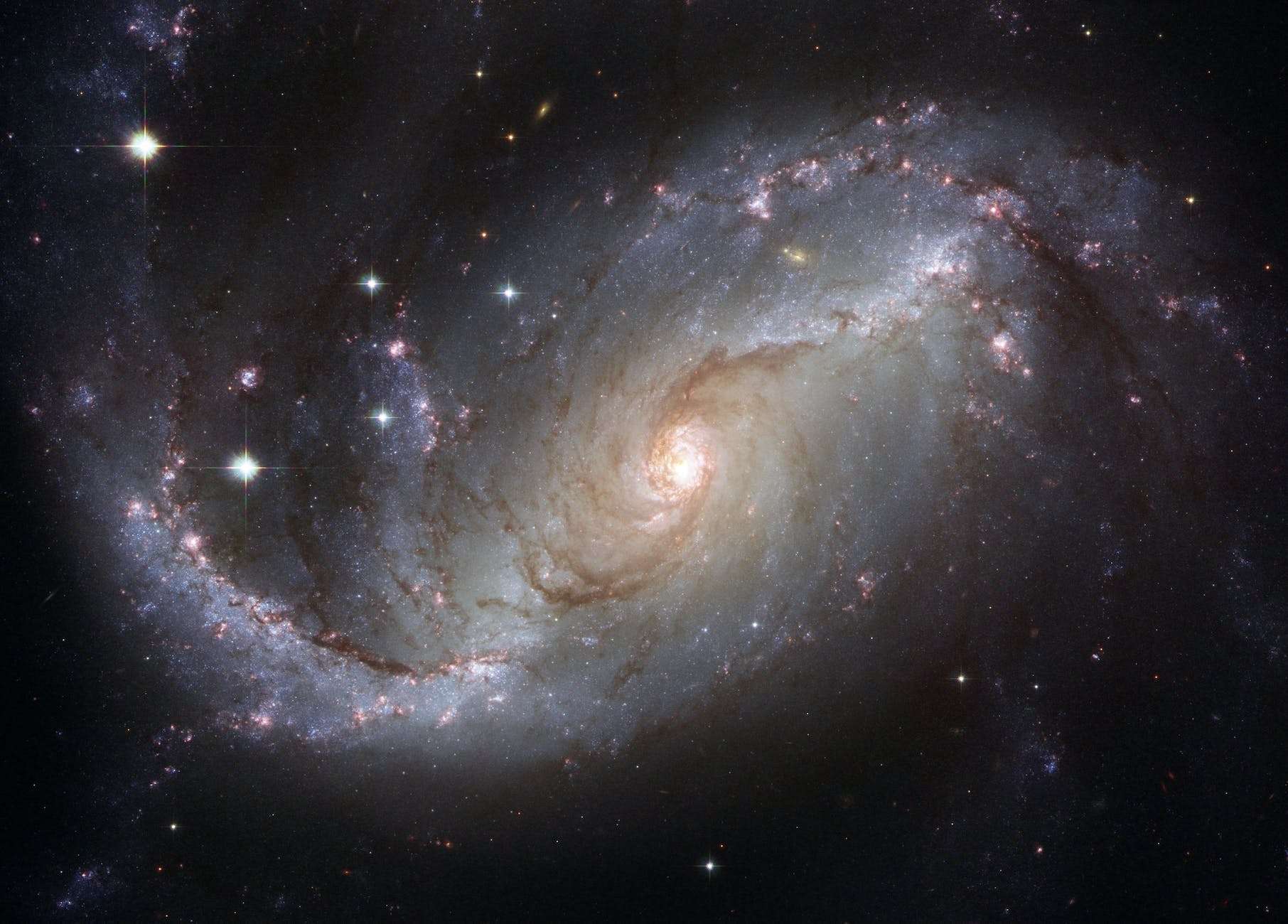
- Milky way Galaxy- मंदाकिनी (slowly swirling)
- Satellite-उपग्रह
- Comet- धूमकेतु
- Asteroid-लघुग्रह
- Constellation-नक्षत्र
- Solar Sys- सौर मंडल
- Mercury-बुध
- Venus-शुक्र
- Jupiter-बृहस्पति
- Saturn-शनि
DAILY ITEM रोज़मर्रा की चीज़= दैनिक वस्तु
- नमक-लवण , हल्दी-हरिद्रा
- दूध- क्षीर / दुग्ध
- घी-घृत
- गिलास-चषक
- खाना-भोजन
- अनाज-धान्य
- किताब-पुस्तक . कलम-लेखनी
- अखबार- समाचारपत्र
NATURE कुदरत = प्रकृति
- रास्ता-पथ, मार्ग
- पेड़-वृक्ष
- हवा-पवन
- खुशबू- सुगंध
- आसमान-आकाश
- बादल-मेघ
- बारिश-वर्षा
- मौसम-ऋतु
- ज़मीन – भूमि
- घास- तृण
- मौसम -ऋतु
- Forest- जंगल/वन
- पहाड़ – पर्वत / गिरि
COLOUR रंग = वर्ण
- काला-कृष्ण / श्याम
- सफेद-शुक्ल / श्वेत
- हरा-हरित
- लाल-लोहित,रक्तवर्ण
- गुलाबी -पाटल
- नीला-नील , पीला-पीत
- बैंगनी-धूमलवर्ण
- Orange-नारंगी
- Grey-धूम्रवर्ण
- भूरा-कपिश
BODY जिस्म = शरीर
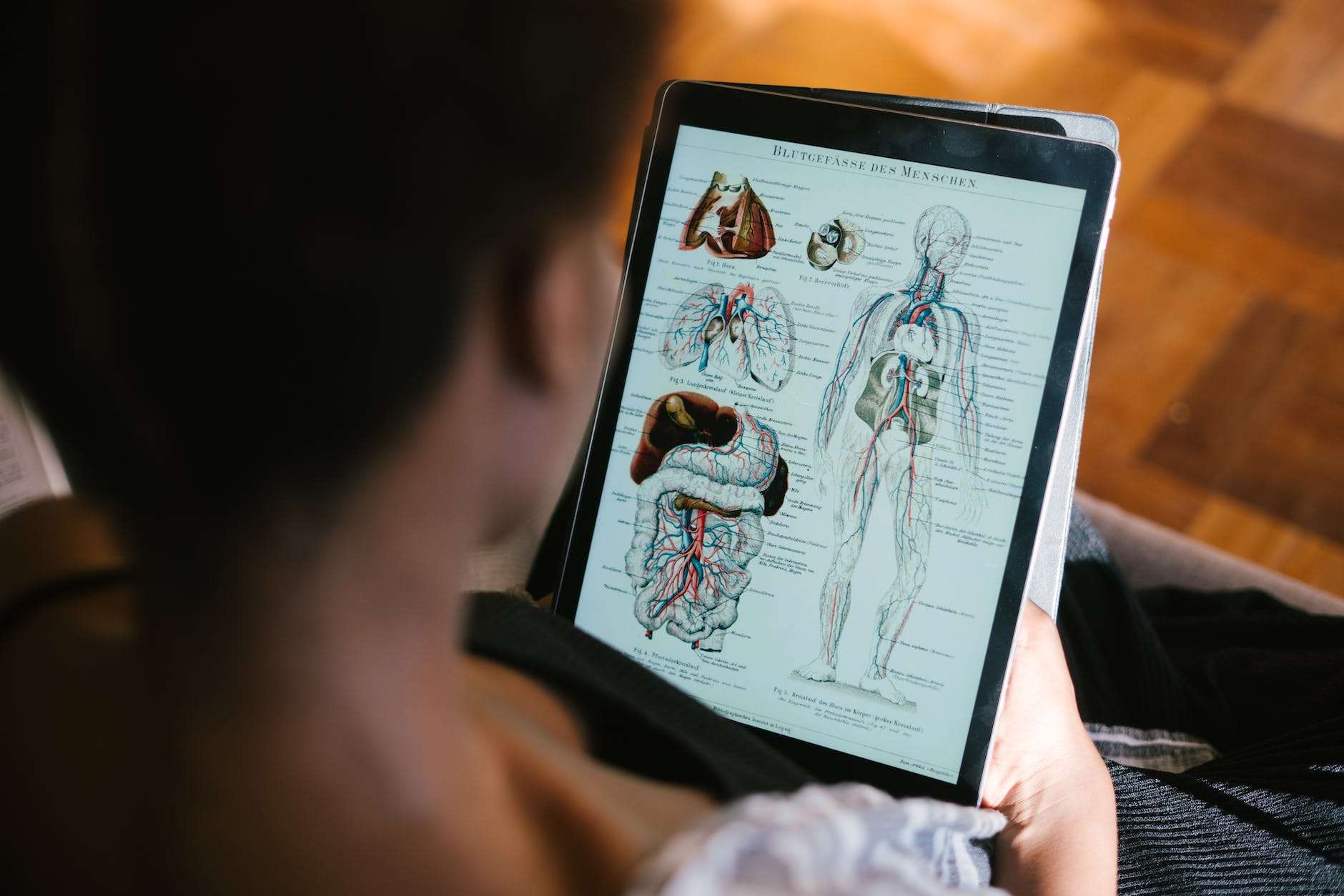
- Nerve – चेतनी
- Gland – ग्रंथि
- रोशनी -दृष्टि
- पसीना – स्वेद
- Womb-गर्भाशय
- उल्टी -वमन
- Embryo -भ्रूण
- Mammals -जरायज
- बीमारी-रोग
- इलाज -उपचार / चिकित्सा
- दवाई – औषधि
- बाल – केश
- माथा -ललाट
- जीभ- जिव्हा
- गला – कंठ
- सीना – वक्ष
- हाथ – कर
- हथेली -करतल
- घुटना- जानु
- हड्डी -अस्थि
- लकवा-पक्षाघात
- सिर – शीर्ष
- लब -ओष्ठ
- कीड़ा – कृमि
- पेट -उदर
- ज़ख्म – घाव
- दर्द – पीड़ा
- बीमारी -रोग
- बचाव -रक्षा
- Face-Mask-मुखावरण
DAILY ITEM रोज़मर्रा की चीज़= दैनिक वस्तु

- नमक-लवण , हल्दी-हरिद्रा
- दूध- क्षीर / दुग्ध
- घी-घृत
- गिलास-चषक
- खाना-भोजन
- अनाज-धान्य
- किताब-पुस्तक . कलम-लेखनी
- अखबार- समाचारपत्र
- Scissor कैंची – कर्तरी
- Needle सूई- सूचिका
COMMON WORDS आम लफ्ज़ = सामान्य शब्द

- एतराज़-आपत्ति
- ईमानदार-निष्ठावान
- मेहनत-परिश्रम
- मतलबी-स्वार्थी
- खुशी-प्रसन्नता
- उम्मीद-आशा
- रोशनी-प्रकाश
- सिपाही-सैनिक
- अजनभी-अपरिचित
- तरफदारी-पक्षपात
- बर्दाश्त -सहन
- नफरत -घृणा
- आसान -सहज
- नज़दीक -निकट
- Mock-उपहास
- Rape-No Word(बल+अतकार=Excess Force)
- Religion-No Word(धर्म is Duty)
- अक्सर-प्रायः
- किस्मत-भाग्य
- किस्सा-घटना
- कानून-नियम
- खून-रक्त
- दास्तान-कथा
- वतन-देश
- सिर्फ-केवल
- शर्म- लज्जा
- जोश- उत्साह
- मुद्दा-विषय
- मौका-अवसर
- हुक्म-आज्ञा
- खुद-स्वयं
- ताकत-बल
- फर्क-अंतर
- ज़ुल्म-अन्याय
- ज़हर-विष
- ज़ालिम-निर्दयी/ क्रूर / अत्याचारी
- ज़ोर से – बल पूर्वक
- अक्सर-प्रायः
- किस्मत-भाग्य
- किस्सा-घटना
- कानून-नियम
- दास्तान-कथा
- वतन-देश
- सिर्फ-केवल
- शर्म- लज्जा
- जोश- उत्साह
- बेकार -व्यर्थ
- मतलबी -स्वार्थी
- बैठिये – विराजिए
- नींद – निंद्रा
- पास- समीप
- सामने -समक्ष
- रोशनी-प्रकाश
- खिलौना-क्रीड़नक
- तस्वीर-चित्र
- गुस्सा-क्रोध
Thank you for giving a patient read. Do inform me if you want me to add some more Words, or you have some clarifications or feel some translations need correction. Your feedback is valuable.
-
Constitution of India – Untold Articles
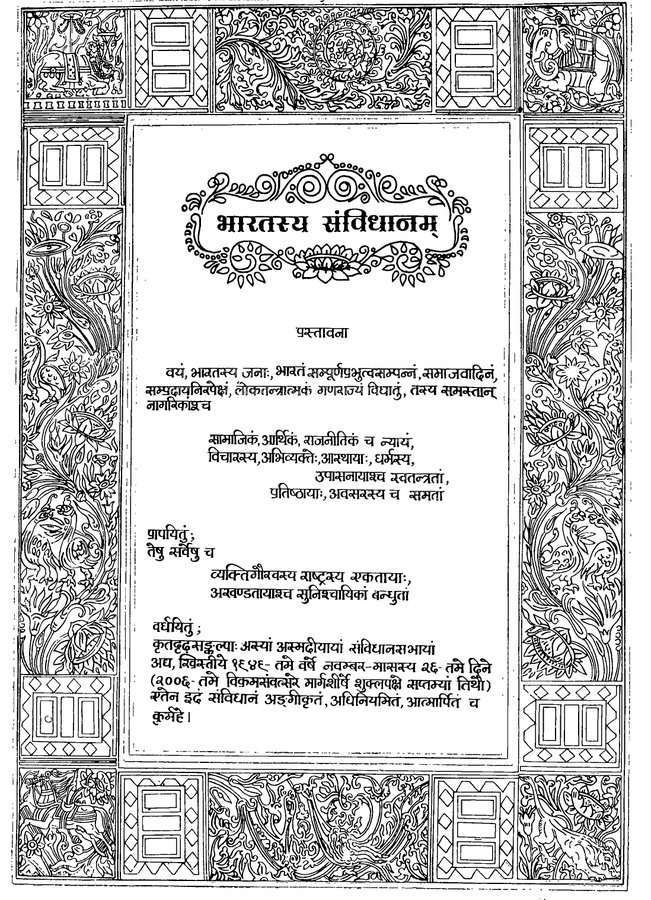
Thru this Article we will know the Aspects of Constitution of India, that’s Bharat, which has been Kept Hidden from us. If we know these Aspects, we can Force the Govts. to Implement for the betterment of Nation Let’s see how. Just Carefully Read and understand Article 44, 48, 28, 25 and 21 of the Constitution. It will Change your view Entirely. Let’s see how.
We will understand what Indian Constitution says about
UCC – Uniform Civil Code
Cow Slaughter
Stone Pelting and destruction of Public Property
Vedic and Dharmic Education in Schools
Respecting National Anthem
Definition of a Hindu
Is Self Defense a Crime?Let’s Start:
Part IV-Directive Principles of Constitution: These principles are Fundamental in governance of country and it shall be the duty of Govt to apply these principles in making laws
Article 44: Uniform Civil Code(UCC): Govt shall endeavor to secure for the citizens a uniform civil code thru-out INDIA.
So even Supreme Court cannot Stop Government to implement UCC as it is enshrined in the Constitution
Article 48: The State shall.. take steps for prohibiting the slaughter, of COWS and calves and other milch and draught cattle.
This makes very Easy for Govt to Ban Cow Slaughter in entire IndiaPart IVA: Fundamental Duties in Constitution
a)to abide by the Constitution and respect its ideals and institutions, the National Flag and the National Anthem.
That Means for Every Indian Citizen it is DUTY to Stand for NATIONAL ANTHEM and Pay Respect to NATIONAL FLAG. Anyone disrespecting Nation Anthem by Not Standing for it isn’t fit to be a citizen of this great country, unless there are serious medical reasons.(h) to develop the scientific temper, humanism and the spirit of inquiry & reform It’s Duty of each Person to Develop Scientific Temper, Humanity & Reform Wrong Practices
Believing in Inhumane, Unscientific Beliefs is Violation of Fundamental DUTY.(i) to safeguard public property and to abjure violence
Stone-pelting, Burning Trains, Damaging Buses, Clashing With Police is Violation of Fundamental Duties, which Govt Must Take immediate Strict Action.Part III: Fundamental Rights (Very Imp)
Article 28 is Often quoted by Many intellectuals as an excuse the Hindus Cannot Teach Vedic or Hindu Education in Schools. Let’s read Read Carefully & Understand. If We understand it Clearly, All Private Schools of India Can Teach Dharmic Studies
Article 28: Freedom as to attendance at religious instruction/religious worship in certain educational institutions:
1) No religious instruction will be provided in any educational institution “Wholly Maintained” out of State funds.
So It’s meaning is very Important. It Means this Restriction is only on Schools which are Wholly Maintained out of State Funds i.e. 100% Funded Funded by Govt. That means All the Private Schools Can Teach Dharmic Education – Vedas, Upanishads, Smd Bhagavad Gita etc. if they So wish Constitution DOES NOT STOP PRIVATE SCHOOLS.28.(2) Nothing in clause (1) shall apply to an educational institution which is administered by the State but has been established under any endowment or trust which requires that religious instruction shall be imparted in such institution.
It is again very supportive. It Means even if an Institute is 100% maintained by Govt. Funds, but operates under a Trust in which Religious Education is a Must, then Religious Education can be Imparted. So, Trusts even under Govt Control, if Religious Education is Required, it’s to be Provided. Other Religions like Christianity and Islam used this Law to Flourish their Preferred Education system. Hindus it seems didn’t utilize much.Article 25 :Right to Freedom of Religion: Definition of HINDU
…Hindus shall be construed as including a reference to persons professing the Sikh, Jaina or Buddhist religion..
Govt can make Laws for opening Hindu religious institutions for all Hindus. Govt can build Temples, Dharamshalas, and infrastructure for Hindus legally.
Article 21: Protection to Life and Personal Liberty
Where you spend money, which food you want to eat, which hotel you want to go, which movie you want to see is your Fundamental Right, No One can Force You to like or dislike anything.
Same Article 21: Protection to Life and Personal Liberty Gives you right to self defense IPC 96 to 106″ and understand the Law Protecting your life against a Fatal attack is your right even if it involves killing the Criminal. The IPC itself says so.

Two Questions to Ponder on for the Govt and aware Citizens.
1-Cant we make it Compulsorily in India to know About Constitution of India, Or atleast Fundamental Duties apart from Rights?
2-Why SANSKRIT Ver. of Constitution is dtd 1985, but Still Not Updated?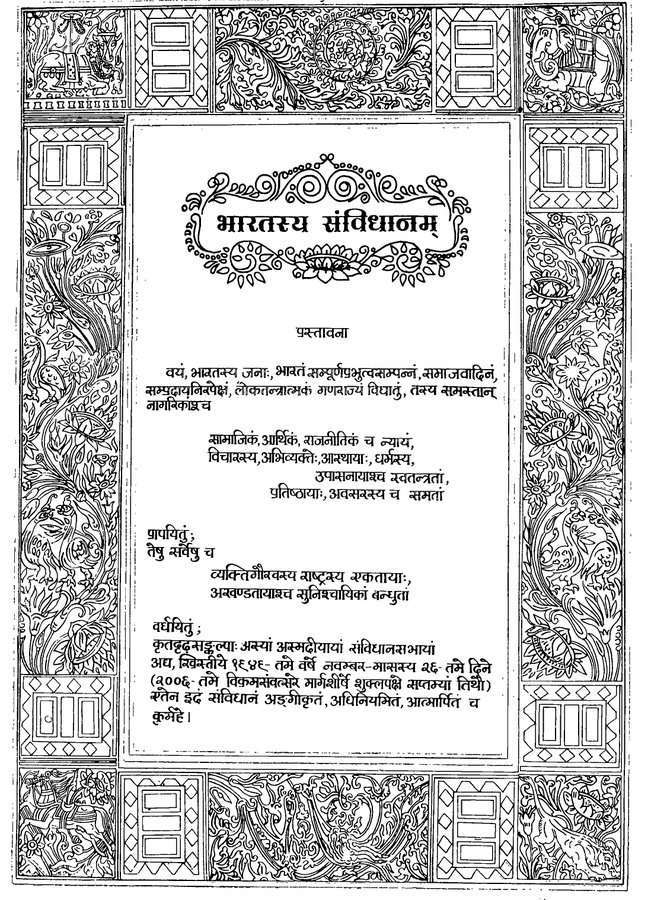

-
MATRIX Movie- unnoticed Sanskrit Verses from Four Upanishads !
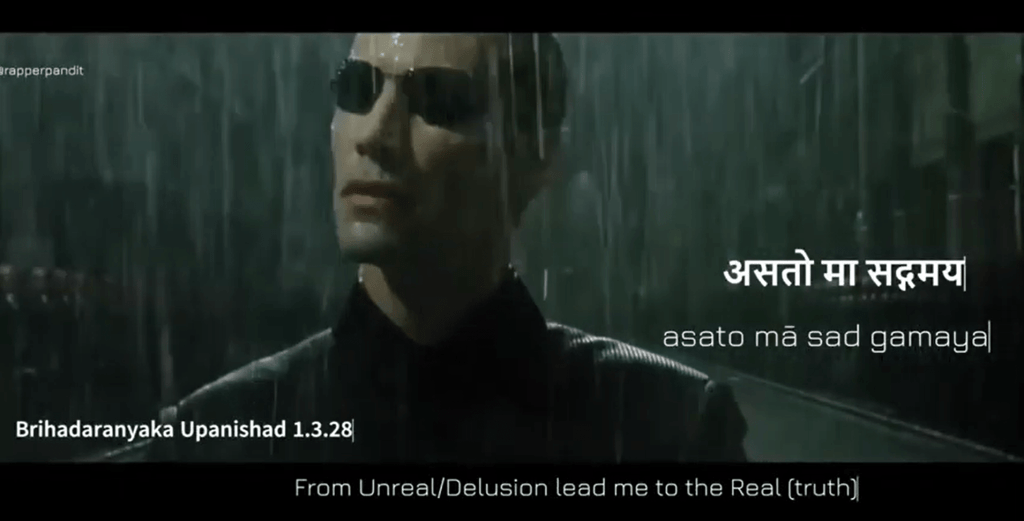
Matrix Movie was a Blockbuster with Concepts hitherto unseen. But today this video will show you the Unexplore and Unnoticed part of it. Do you Remember the Neodammerung Song- a Duel between Neo (Mr. Anderson) and Powerful Agent Smith under the downpour. A brainchild of Composer Don Davis and Director Lana Wachowski (earlier Larry Wachowski) , the lyrics and its meanings will leave you spell bound. These Verses
This Song used Samskrit Verses four different Upanishads for its Lyrics. Upanishads are a Part of Vedas- Worlds Most Ancient and Divine Text.
Brihadaranyaka Upanishad, Isha Upanishad, Mundaka Upanishad, Katha Upanishad, and an Allusion to Smd. Bhagavad Gita. Dive Deep into this Song.
Matrix and Upanishads -
The Secret of ChakraVyuh चक्रव्यूह
Chakravyuh (चक्रव्यूह) in Mahabharata remains a Topic of great curiosity and a marvel of pure military genius. Only the Greatest Experts could solve this riddle. From Kaurvas Guru DronAcharya created it on the 13th Day of the War in order to Capture King Yudhishthira and End the War at one go.
Among the Pandavas, only the Great Arjuna knew the Secret to both enter in it and also come out of it. Apart from Arjuna, it is said only Bhagwan Sh Krishna knew the secret. On the 13th Day, on the advise of Guru DronAcharya, Duryodhana thru Samsaptakas, got Arjuna and Krishna away from the spot where Chakravyuh would be initiated.
However, it was Abhimanyu, the son of Great Arjuna, who knew the Secret to Enter in it, but didn’t know how to come-out of it. He had listened to the technique of getting in, while in the Womb of her mother.
Today we will learn how Brilliant Abhimanyu Entered into the Chakravyuh, First see the Greatness of Arjuna, and the Vyuhs created daily in Mahabharata War.
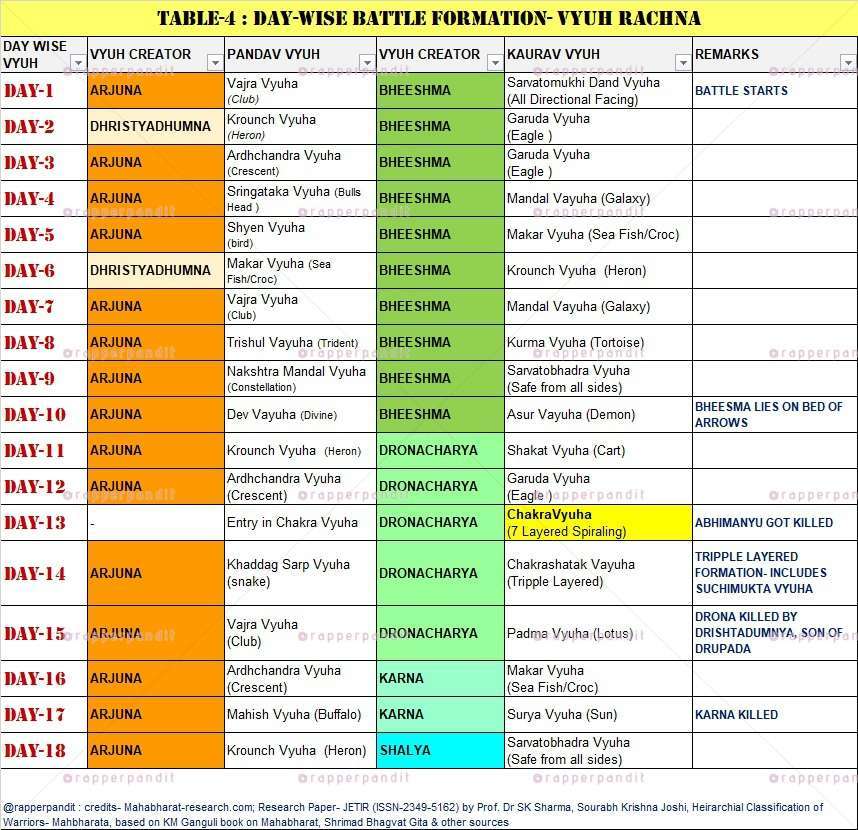
Now Let’s understand the brilliance of ChakraVuyh
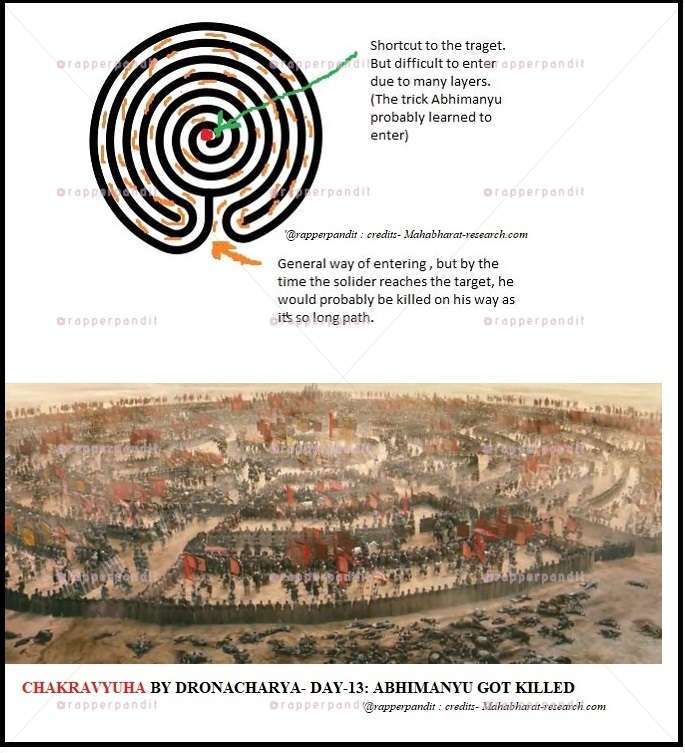
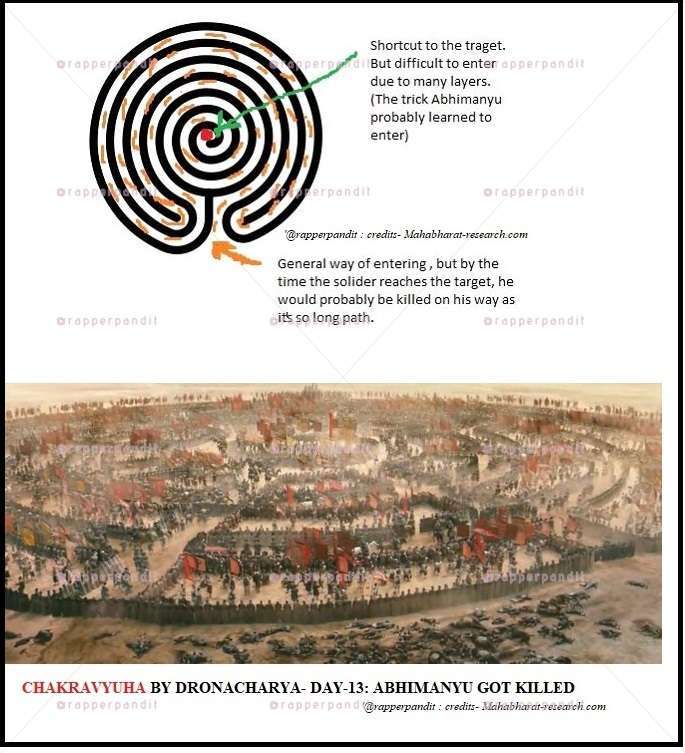
Let’s now focus on the three images below carefully and understand how Abhimanyu Solved the ChakraVyuh Entry. Unfortunately, he couldn’t come out of it and was killed by the Kaurva warriors inside.
The Art of getting in , is itself mesmerizing.
A) The First Image below Shows simplified 1 Layer Functioning of Chakravyuh. The Chakravyuh is said to have seven layers.

B) The Second Image below Shows how spiraling soldiers replenish each Other and don’t let enemy to Breach inside, making it impregnable

C) The Third Image below Shows the Genius Strategy of Abhimanyu used to Breach the Chakravyuh

However, unfortunately Abhimanyu could only get in but not Get out. The Secret of Coming out is hidden from everyone. May be a similar strategy used. What do you think. Do give your inputs, and share it to maximum youngsters so that they feel proud of the Genius of the Ancients. Thank you !

-
Subscribe
Subscribed
Already have a WordPress.com account? Log in now.
 Ancients