-
Minimum Age for Marriage in Hinduism !

Sanatan Dharma is the Eternal Dharma. Now popularly made to be known as “Hinduism”. Sanatan Dharma is based on Logic, Reasoning & Science
When your kid is asked in Class, what are the Evils in Hinduism? he will Reply with head down: Child Marriage & Sati Pratha.
But whether they are part of our Dharma or Creeped in our Society, we must probe it. Today we will discuss and arrive at a conclusion thru Evidence, logic & Reasoning.
Sushruta Samhita through a Medical approach as per readiness of human body and Manusmriti from the perspective of Dharma and Society, arrived at the same conculsion that Minimum Age for marriage of Male ≥25 yr and for Female atleast ≥16 yr. Please again atleast sixteen means it can be in 20s as well. It straight away rules out the concept of child marriage in Males or Females both as per ancient medical authority and dharmic scriptures.

Sushrutas View from a Medical Perspective on Marriagiable Age 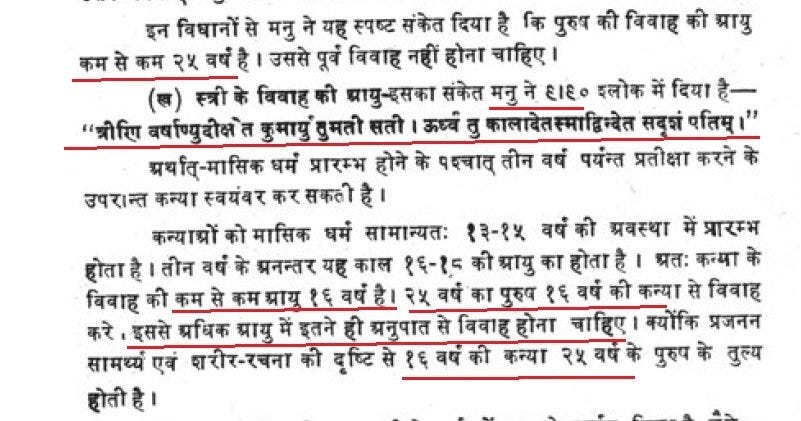
Maharishi Manu View from a Dharmic/Social View for Marriageable Age However the question remains why in border areas and especially in North India the evil of Child marriage is sometimes witnessed.
Now that we are satisfied the Hindu Dharma doesn’t support it, we should understand that the areas of Rajasthan, North West India, UP, Bihar have faced most brutal onslaughts from the invaders who had two important beliefs:
- There is no minimum marriageable age for a girl
- They have full right on Maal-e-Ganeemat (The War Booty). Women as a part of War Booty had no right and could be traded, sold, used and misused for fun and money just like objects.
Child Marriage Or Ghunghat Pratha Wrongly creeped in our society , when girls were considered Maal-e-Ganimat (War Booty) by the Invaders. Girls began to be seen as liability.
One Strong Logic that these were not a part of Our Ancient Society before invaders is that there is not a single temple before 12th century AD with carving depicting Child Marriage or Ghunghat.
These Days it has become a Fashion to Marry Late. But Lets understand the Pros and Cons. A Very Early marriage will be a compromise on Education and Career related Goals. However a Late Marriage, say after 30s will be a grave mistake. Late marriages have below issues:
- Miscarriages in Females
- Low Sperm-Count in Males
- Higher Chances of Abnormality in Children
- Less Probability of Bearing a Second Child
- Very Less Probability to Enjoy Grandparenthood.
Let’s understand by an Example:
There were two persons in a society. Mr. On-Time after completing MBA and getting job, marries at the age of 25 and Mr. Off-Time gets job but procrastinates marriage and finally gets married at the age of 35. They have found their spouses are a year younger.
Mr On-Time : Marries at 25, after three years, blessed with 1st Kid at 28 and 2nd Kid at 32 years with a gap of 3–4 years. When his first child reaches 25 years he is only 53 years of age, still in Job, Fit and Fine. When the second Kid is 25 years Old, Father is 57 Years old , still in Job, Fit and Fine. He become a Grandpa twice at the Age of 56 and 60 . He is fit and fine to enjoy the blossom of the progeny.
Mr Off-Time :Marries at 35, however conception is tough. after five years using IVF, blessed with 1st Kid at 40, but struggles for 2nd kid as there is a miscarriage twice. When his Only child reaches 35 years , like father he plans to marry. But the Father is now 75 years Old, frail and week. Job is over , only little savings left. He is blessed with a granddaughter at the age of around 80. Quite Old to enjoy the time with Grandchildren .
So be On-time. 24–25 is the perfect age to marry for both boy and girl, without compromising academically or through a career point of view. Please Note that as per Hindu Tradition the one of the most important role of Humans is Paropkaar परोपकार — What do we contribute for the Welfare of the society. Producing Learned and Virtuous Children who contribute to the society is an important responsibility of Grihasth Ashram. Imagine if the mother of adiShankaracharya, mother of Bal Gangadar Tilak, Mother of Veer Savarkar, Mother of Chatrappati Shivaji Mahraj, Mother of Mahrana Pratap, Mother of Guru Gobind Singh ji mahraj and many other greats would have thought to not produce any kids and enjoy their own lives, how would the humanity have been.
The Logic for Min 25 Years is as below pic. To Qualify for studying only 1 Veda and complete Brahmacharya Ashram & Progress to Grihasth ashram min 24–25 years were required (divinities like adiShankara are an exception ) People who studied more than 1 Veda would take more time.
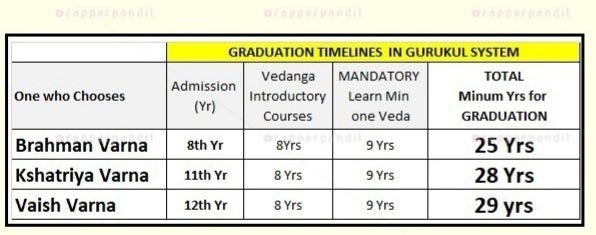
Approx graduation Age for Various Dwij (1 Veda) Immediately some will ask two Questions:
- Why is Shudra Varna not mentioned Here
- What about Women
Let’s understand one by one.
Varna root word signifies Choice. Example: You choose Graduation and Dont want to Pursue MBA for say reasons below:
- Financially it is taxing
- You don’t have time and patience for it
- You have better options like job or business
- You think you are not academically sound
Similarly pursuing or Not Pursuing Dwij Varna is a Choice. Nowhere does authentic Manusmriti ban Vedic Studies for Shudra. However, it may not be essential and required for his kind of lifestyle. I have made a simple flowchart that will help you easily understand the concept.
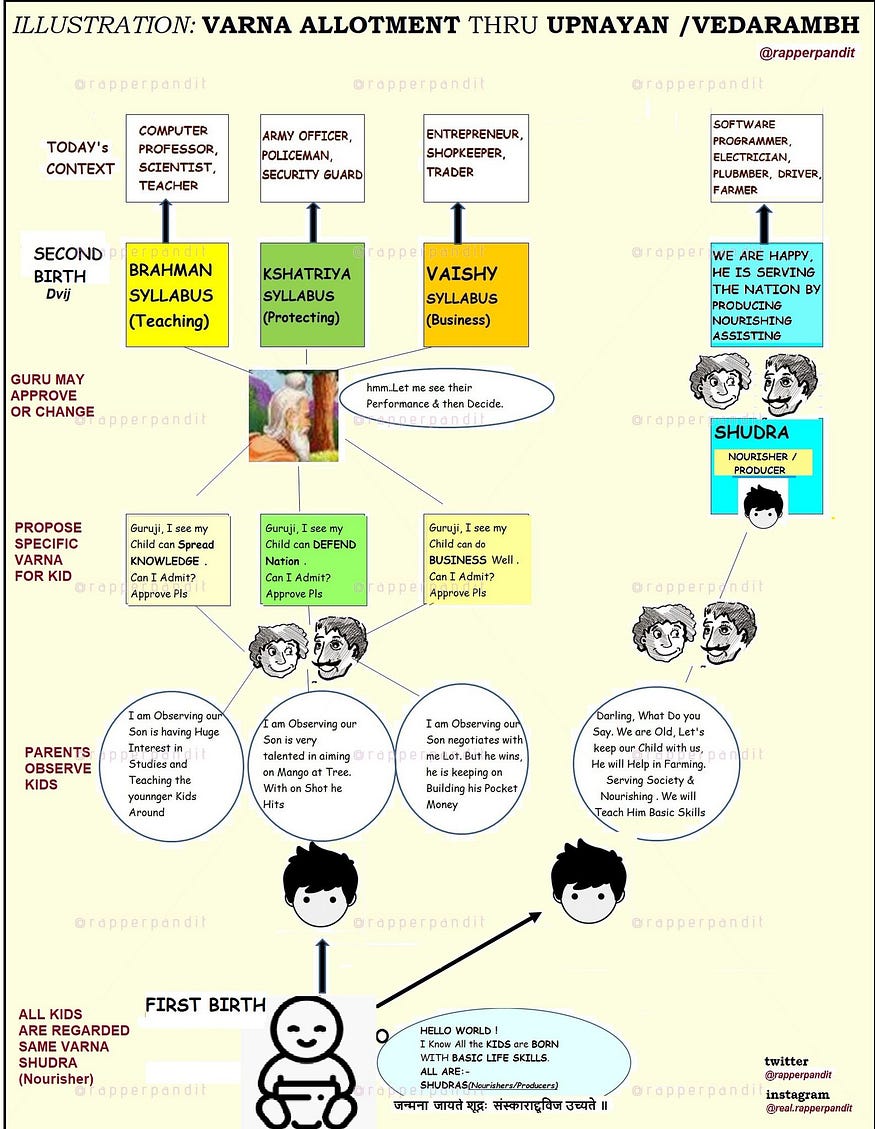
Now Let’s understand why Less women will read Vedas before Marriage. Please note that Vedanga Course is of min six years , followed by Each Veda around nine years. While men would go on to be dwivedi/trivedi or even chaturvedi thereby continuing their brahmacharya ashram till 40s, however if women would do so, they could loose their time of 20s and 30s with most fertile magic of bringing new life to world in 40s. However some women would do so, they were called Brahmavadinis, compared to Sadyodvahas who would continue marriage and be a part of rituals and Vedic studies side by side. Hindu Ladies will be proud to know that concept of Rishikas (Female Seers), Upadhyayinis ( Female Teachers) were mentioned often in Vedic times. Infact many revelations of hymns in our highest Revered Vedas have been to the Rishikas. Example- Rig Veda is abundant in hymns revealed to Rishikas. The pics below give an example how Vedas revered and respected the females. It also gives some hymns of Rig Veda revealed to Rishikas
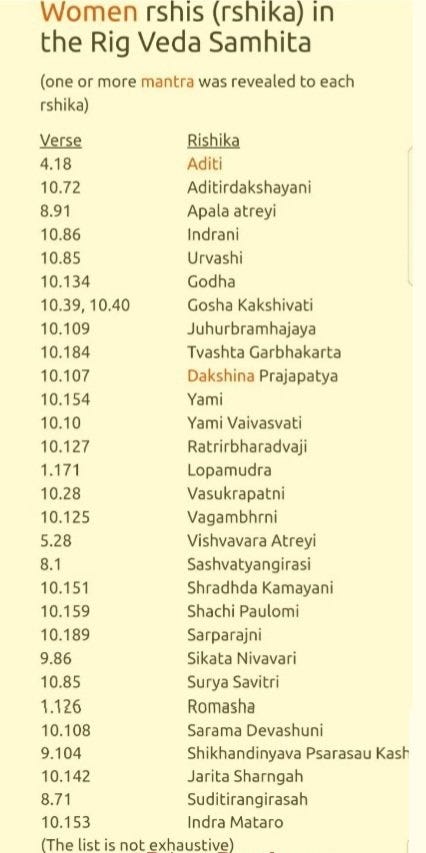
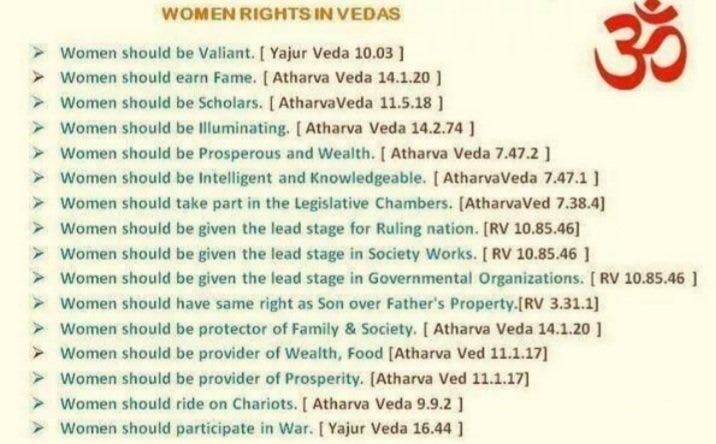
Next time someone Tells you that Hindus don’t respect women and practice Child marriage present them above evidence.
Also subtly leave in their mind this million dollar question:-
Which religion today apart from Hindu Dharma worships female deities and that too equal to male deities?
-
History of Pakistan- As they see it
As an Indian, I was always curious to know what Pakistani children are being taught in their History books. Is the Ancient Indian History also included, or is it from the time of Partition of Pakistan from the Undivided India ( the Akhand Bharatvarsha) in 1947
The area of Pakistan is an important part of ancient history from India’s perspective. Be it the Shardapeeth or the Taxila as the Centers of Learning, or be it the Lahore (named after son of Bhagwan Ram, Luv) , or be it Multan named after Moolasthan with magnificent Sun Temple, or be it Rawalpindi named after Bappa Rawal ‘s military posts, or be it the Saraswati civilization or the Harrapan civilization that was conveniently de-Hindunized. So what was it, that was being taught in the History books of Pakistan.
With these thoughts in mind, I wanted to explore the History books of Pakistan. Normally getting catch of the history books from 6th class to 10th class gives a broad perspective of the direction of the narrative. So I got hold of History book (part of Social Studies) from the Punjab Curriculum and Textbook Board, Lahore. Much of the content is in Urdu and Persian, which I am not strong at. So I took hold of a social studies book (in english) of the Pakistan’s education board, posted online by topstudyworld.com
Now this is like a Crash Course of Pakistan’s Ancient and Modern History as they see it. Some of it is blunt truth, and some is convenient truth. Let’s visit the History of Pakistan as they see it.
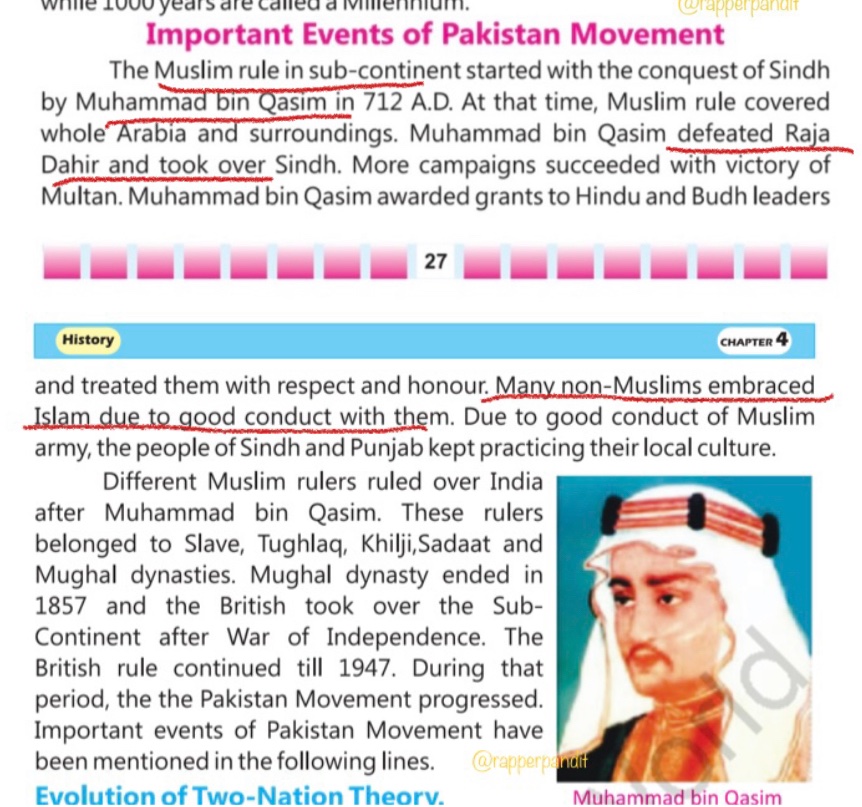
- Their Ancient History Starts and Ends with Mohd Bin Qasim, who defeated Hindu Raja Dahir in 8th Century and took over Sindh. But what happened before and after that for 500-600 years before the Mughal rule in 1506 AD is missing. The resistance before and after put up by the Hindu rulers is missing. Mohd bin Qasim is projected as kind & secular. Also it is mentioned that non-Muslims converted to Islam on their own due to good conduct by Muslims.
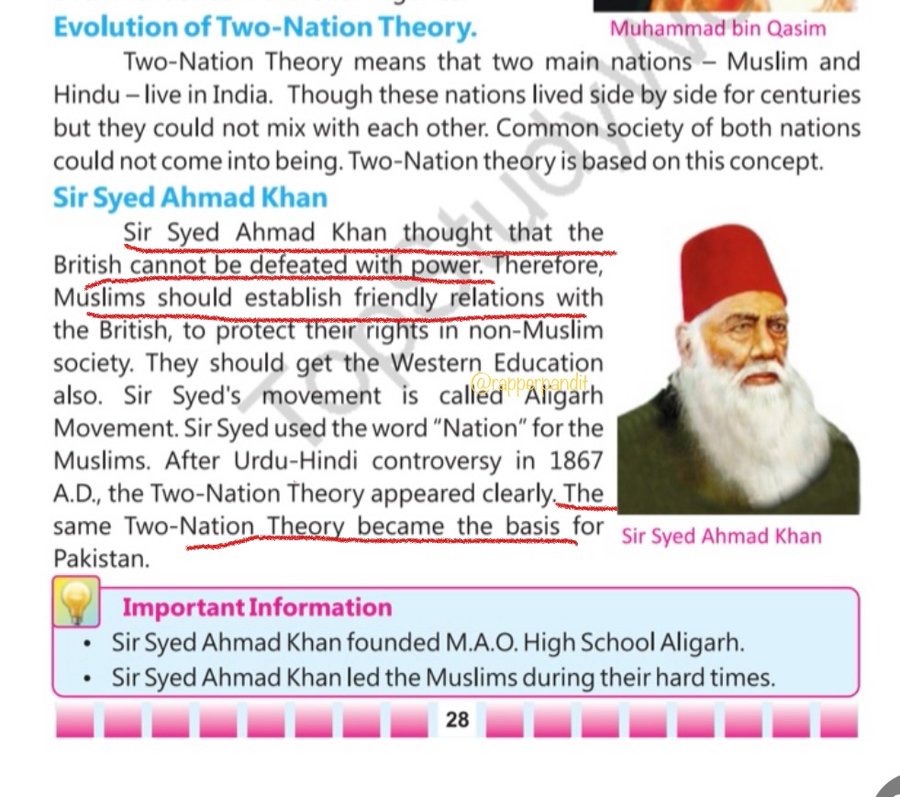
2. Then Comes ‘Two Nation Theory’ (1867)
Two Nation theory means the theory of creating two Nations from one Nation of India – one for Muslims and one for Non Muslims. While in India from one political party to other there are various views on who is responsible for two Nation theory, but the Pakistan’s textbook clearly credits Sir Syed Ahmad Khan.
He wanted to establish friendly relations with British by clearing air on 1857 mutiny. He firmly believed Muslims and Hindus cannot live under one roof due to ideological differences. He felt Muslims are being left behind in the Government participation due to lack of education compared to Muslim counterparts, hence he supported Modern English education and was behind Mohammadan Anglo University or Aligarh Muslim University in India and is held in High esteem in India.
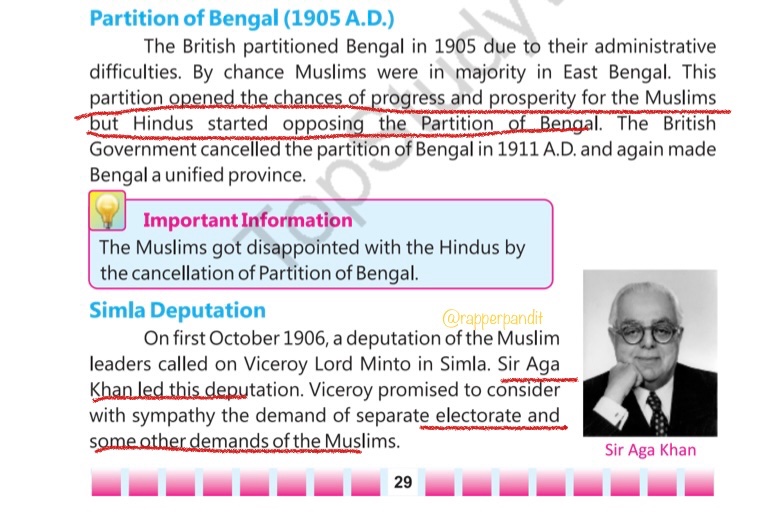
3. Then comes ‘Partition of Bengal’ (1906 AD)
This was First trial by British in favor of Muslims as a precursor to 1947 by dividing Bengal into West (Hindu Majority) and East Bengal (Muslim Majority) . While Muslims were happy , but Hindus opposed it thru protests. British had to roll back the partition.
Then Simla deputation for exclusive Muslim electorate under Sir Aga Khan happened. This was highly communal in nature.
4. Then Muslim League in 1906
Their Objectives
1. To cooperate with British Government
2. To protect rights of Muslims
3. To develop relations with Muslim friendly countries
Mohd. Ali Jinnah was made the Boss. It is interesting to know that Mohd Ali Jinnah’s forefathers were Outcast Hindus. Jinnah Or Jina bhai means a man with thin wiry structure of body.

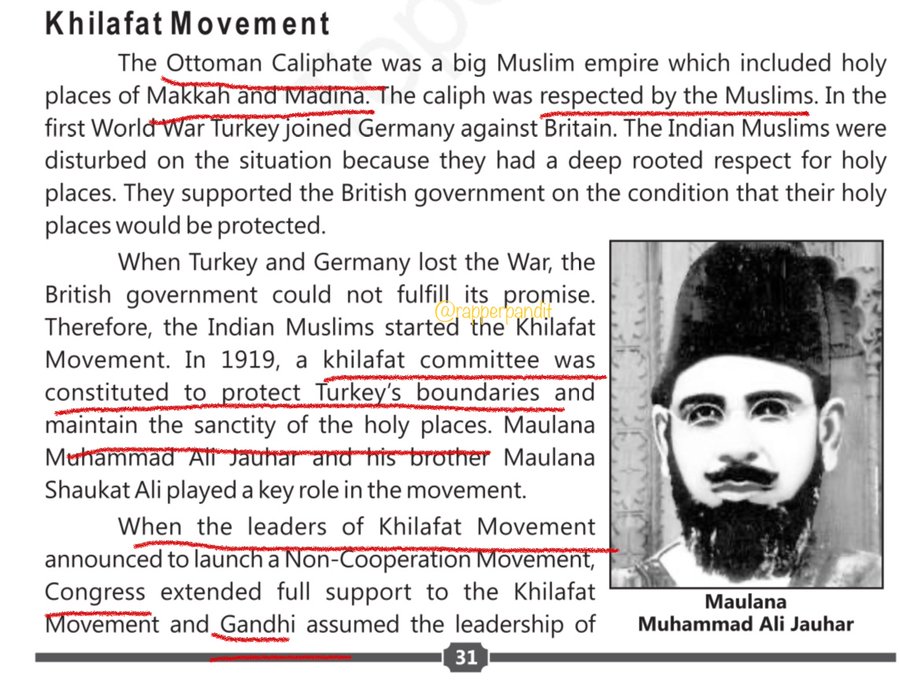
5. The Khilafat Movement (1919)
Turkey was an ally of Germany against the British in World War-I. After the closure of World War-I in 1918 ending, since Germany was defeated, Muslims feared the British May attack the holy Sites of Islam. Since Turkey was the center of Ottoman Empire (which finally fell in 1920s), Mecca-Medina and Many Holy sites for Muslims were under the threat in Muslim minds, considering Long history of crusades and cross crusades among Middle-East and Europe. So immediately in 1919 many Muslims from undivided India went to Turkey and bordering areas to save the Holy sites. Indian National Congress and Gandhiji fully supported them.
The main aim was to protect Caliphate of Turkey and to protect Mecca Medina. However, in India average person thinks Khilafat movement was some kind of local boycott of the British

6. History of Indian National Congress
The book has explicitly presented the formation of Indian National Congress.
Offered, without comments. It is for the reader to Judge Now.

Thank you for a patient read.

-
Subscribe
Subscribed
Already have a WordPress.com account? Log in now.
 Ancients